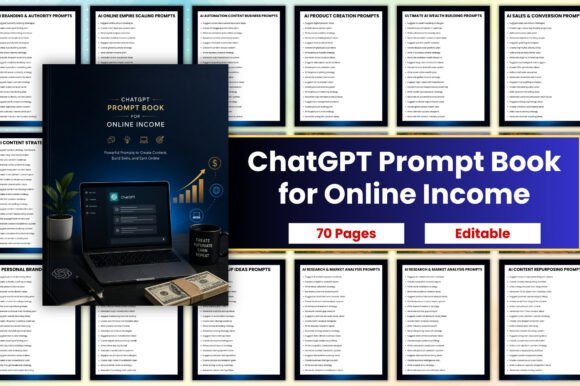
ChatGPT Prompt Book for Online Income
If you have spent any time exploring what AI can do for your business, you have probably noticed a pattern: the quality of what you get out depends heavily on what you put in. A vague question returns a vague answer. A well-structured prompt, on the other hand, can deliver insights, copy, strategies, or even entire workflows that save you hours. That is the gap ChatGPT Prompt Book for Online Income aims to close. It is not a general guide to ChatGPT. It is a focused collection of prompts built around one goal: helping you generate revenue, build systems, and grow a digital presence with less guesswork.
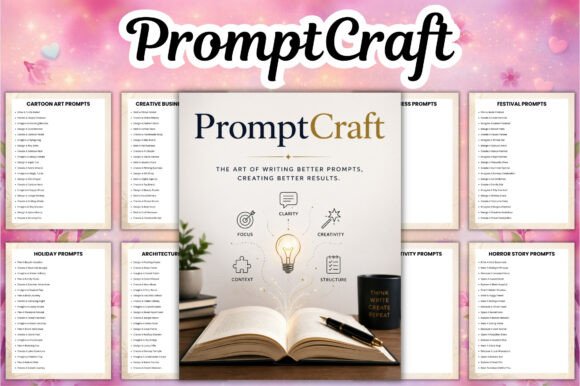
This resource contains 3000 prompts organized into categories that reflect real business needs. Freelancers, creators, marketers, entrepreneurs, and digital professionals will find material they can adapt immediately. The prompts are designed to be editable, which means you can take a structure that works and tweak it for your niche, audience, or platform. That flexibility is important because no two online businesses operate exactly the same way.
What Makes This Collection Different
Many prompt libraries are thrown together quickly. You get a few dozen generic examples and a promise that they will transform your workflow. This book takes a more systematic approach. The prompts are grouped around specific outcomes like scaling a freelance agency, creating passive income streams, building personal authority, or automating content workflows. Each category contains prompts that range from strategic planning to tactical execution.
For example, the section on viral growth content strategy does not just ask ChatGPT to write a catchy post. It walks you through audience research, hook generation, format selection, and distribution timing. The prompts work together like a checklist, so you can move from idea to published content without jumping between tools or tabs. That kind of integration saves time and keeps your thinking coherent.
Another strength is the emphasis on psychology and persuasion. The customer psychology section includes prompts designed to uncover buyer motivations, frame offers more effectively, and reduce friction in your sales process. These prompts are grounded in behavioral principles, not just guesswork. If you have ever struggled to write copy that actually converts, this category alone can shift how you approach messaging.
Practical Applications Across Income Streams
The book covers a wide range of income models, which makes it useful whether you are just starting out or already running a digital business. Here are a few areas where the prompts can be applied directly:
- Freelancing and agency work. Prompts help you create proposals, scope projects, set pricing, and communicate with clients. The agency scaling section includes prompts for hiring, delegating, and systematizing repeatable work.
- Digital products. You can generate product ideas, outline course content, write sales pages, and create launch sequences. The passive income prompts focus on products that require upfront effort then deliver ongoing revenue.
- Personal branding. Prompts guide you through positioning, content pillars, platform selection, and engagement strategies. The personal authority section is useful if you want to be seen as a go-to resource in your field.
- Content automation. For those running faceless brands or multiple channels, the automation prompts help you schedule, repurpose, and optimize content without constant manual input.
- SEO and audience growth. You get prompts for keyword research, topic clustering, title optimization, and internal linking. These are practical enough to use during your regular content planning.
Each category includes prompts that target different stages of the process. You might use one prompt to brainstorm, another to draft, and a third to refine. That layered approach gives you control over the output without having to rewrite everything from scratch.
How It Works in Real Scenarios
Let me give you a concrete example. Suppose you run a small freelance writing business and you want to raise your rates without losing clients. The book includes prompts that help you articulate your value, prepare for rate conversations, and craft emails that position the increase as a natural step. You can take the prompt, paste it into ChatGPT, add your specific details, and get a draft that feels personal rather than generic.
Or imagine you are launching a digital course. The product creation monetization section includes prompts for validating your topic, structuring your modules, writing lesson scripts, and creating a launch sequence. Instead of staring at a blank page, you have a framework that guides your thinking. The prompts do not do the work for you, but they remove the friction of starting.
Another scenario involves content repurposing. If you record a podcast or a video, you can use prompts from the content automation section to turn that single piece into social posts, email newsletters, blog summaries, and Twitter threads. That kind of efficiency matters when you are trying to maintain a presence across multiple platforms without burning out.
Who Benefits Most from This Approach
The book is designed for adults between their twenties and fifties who are serious about building online income. That includes freelancers who want to scale beyond trading time for money, entrepreneurs testing new business models, creators looking to systematize their output, and marketers who need to produce consistent content. It also suits educators and coaches who want to package their expertise into digital products.
If you are a hobbyist exploring ways to turn a side project into revenue, you will find prompts that help you validate your idea and test demand before investing too much time. If you are a seasoned business owner, the scaling and automation prompts can help you identify bottlenecks and delegate more effectively. The range is broad, but the prompts stay grounded in practical outcomes.
Practical Considerations When Using Prompt Libraries
No prompt book works if you treat it as a magic button. The real value comes from how you adapt the prompts to your specific context. ChatGPT Prompt Book for Online Income provides the structure, but you need to bring your own knowledge, audience insights, and goals. The best approach is to pick one category that matches your current priority, test a few prompts, and refine the outputs until they match your voice.
Another consideration is consistency. Using prompts occasionally can help in a pinch, but integrating them into a regular workflow creates compounding benefits. If you use the same prompt structure each week for your content planning, you develop a rhythm that reduces decision fatigue. The prompts become a template you can rely on rather than a novelty you try once.
You should also treat the outputs as drafts, not final products. ChatGPT is a tool for generating raw material quickly, but your judgment is what turns that material into something valuable. Edit, personalize, and fact-check before publishing or sending. The prompts are meant to accelerate your process, not replace your expertise.
The book is delivered as an editable format, which is a practical detail worth noting. You can copy prompts directly, modify them to fit your niche, and save your versions for future use. That saves time compared to retyping or reformatting every time you want to use a prompt.
Finally, keep an eye on the categories that stretch beyond your current comfort zone. You might start with the freelance prompts but discover value in the business validation or financial planning sections later. The book covers enough ground that you can grow into it as your business evolves.
Building online income requires a mix of strategy, execution, and consistency. Tools like this prompt collection help with the execution part by removing the friction of starting and structuring your thinking. When used intentionally, they become a practical asset in your workflow rather than just another resource on your hard drive.