Enter Your Discipline Era Workbook
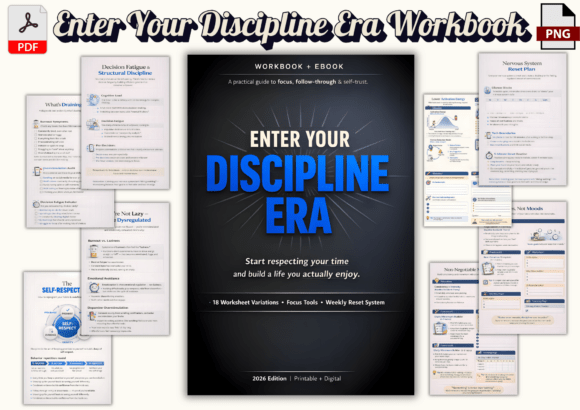
Motivation is unreliable. It shows up when you feel inspired and vanishes the moment you face resistance, leaving you with half-finished projects, unmet goals, and the nagging sense that you could be doing more. The Enter Your Discipline Era Workbook offers a different approach—one that builds consistent action through systems, habits, and environment design rather than fleeting willpower. This 37-page guided workbook, available as a printable PDF and PNG in a compact 6 x 9 inch format, helps you move from sporadic effort to steady progress by teaching you how to make discipline feel almost automatic.
Why discipline matters more than motivation
Most people rely on motivation to get started, but motivation naturally fluctuates. You may feel excited about a new project on Monday and completely drained by Wednesday. The Enter Your Discipline Era Workbook addresses this directly by drawing on behavioral science and productivity psychology to show you how to create conditions that support consistent action regardless of how you feel. Instead of waiting for inspiration, you learn to design routines and environments that make the right choices easier. This shift in perspective can be transformative for anyone who has ever struggled to follow through on goals they genuinely care about.
The workbook explains why discipline feels hard and what you can do about it. Educational pages walk you through the psychology behind procrastination, decision fatigue, and habit formation. Understanding these mechanisms helps you stop blaming yourself for lack of willpower and start adjusting the systems that surround you. When you see discipline as a skill you can build rather than a trait you either have or lack, the path forward becomes clearer and more achievable.
18 practical frameworks that replace guesswork with structure
The Enter Your Discipline Era Workbook contains 18 frameworks and worksheets designed to address specific productivity challenges. These are not abstract theories but actionable tools you can apply immediately. For example, the decision-fatigue reduction tools help you streamline daily choices so you preserve mental energy for what truly matters. The distraction elimination strategies guide you through identifying your most common interruptions and building safeguards against them. Every framework serves a clear purpose and connects to a real-world situation you likely face.
One of the most useful elements is the environment design worksheet. Your surroundings shape your behavior more than you realize. A cluttered desk, a phone within arm’s reach, or a workspace that lacks clear boundaries can undermine even the strongest intentions. This worksheet helps you audit your physical and digital environments and make targeted adjustments that support focus. After completing it, many users report feeling less resistance when starting tasks and fewer temptations to check social media or email during work sessions.
Reflection prompts that build self-trust
The workbook includes reflection prompts and guided exercises that go deeper than typical journaling questions. These prompts ask you to examine your past patterns, identify what has worked and what has not, and clarify why your goals matter to you. This process builds self-trust because you begin to understand your own tendencies and how to work with them rather than against them. When you follow through on small commitments you make to yourself, you prove that you can be relied upon. That trust compounds over time and makes larger goals feel more attainable.
The 30-day discipline commitment contract is a standout feature. It asks you to specify one habit or behavior you will practice daily, define the conditions under which you will do it, and sign the contract as a personal pledge. This act of writing and signing creates a sense of accountability that informal promises lack. You can place the contract somewhere visible as a daily reminder of your commitment. After thirty days, the behavior often becomes automatic enough that you no longer need the contract to maintain it.
Who benefits most from this workbook
Students facing heavy workloads and competing priorities can use the weekly reset and planning templates to organize their time and reduce last-minute cramming. Entrepreneurs juggling multiple responsibilities will appreciate the focus and productivity frameworks that help them identify high-impact tasks and protect time for deep work. Professionals in demanding careers can apply the decision-fatigue reduction tools to streamline their workflows and preserve energy for strategic thinking. Freelancers and creators who manage their own schedules often find the environment design worksheets particularly valuable because they help establish boundaries between work and personal life when working from home.
The Enter Your Discipline Era Workbook also suits hobbyists and lifelong learners who want to make consistent progress on projects they care about but often set aside. Whether you are learning a new language, writing a novel, or practicing an instrument, the habit-building and self-trust systems give you a reliable structure to follow. Small business owners and marketers who need to balance creative work with administrative tasks can use the distraction elimination strategies to stay focused during critical work periods.
Realistic use cases for different goals
Imagine you are a blogger who wants to publish twice a week but frequently gets derailed by research rabbit holes and social media breaks. The focus frameworks help you set time limits for research and schedule social media check-ins at specific intervals rather than whenever the urge strikes. Over several weeks, this structure turns an inconsistent publishing schedule into a reliable routine.
Consider a small business owner who feels overwhelmed by daily decisions about which task to tackle first. The decision-fatigue reduction tools guide you in creating a decision hierarchy and batching similar tasks together. Instead of starting each morning unsure where to focus, you follow a preset sequence that aligns with your energy levels and priorities. This simple change can free up hours of mental bandwidth each week.
For a professional preparing an important presentation, the weekly reset and planning templates help you break the work into manageable stages and track progress without panic. You avoid the common trap of cramming everything into the night before because the templates force you to think ahead and allocate time appropriately. The result is a higher quality presentation delivered with less stress.
Practical considerations and how to use the workbook effectively
The Enter Your Discipline Era Workbook is 37 pages long and designed for both printing and digital use. The 6 x 9 inch format makes it easy to carry or store in a binder. If you prefer working digitally, you can use the PDF or PNG files with a note-taking app like GoodNotes, Notability, or OneNote. The structured layout means you can complete sections in any order, though working through the educational pages first gives you a foundation that makes the exercises more meaningful.
You may find that certain frameworks resonate more than others depending on your current challenges. That is fine. The workbook is not meant to be consumed in one sitting. You might spend a week on the habit-building sections and then return to the distraction elimination strategies when a new source of interruption appears. The 30-day commitment contract works best when you choose a single habit to focus on rather than trying to overhaul everything at once. Slow, consistent progress produces more lasting change than rapid, scattered efforts.
Possible limitations to consider
No workbook can replace professional support for serious issues like chronic procrastination linked to anxiety or attention disorders. If you suspect an underlying condition affects your ability to focus, consider consulting a therapist or coach who can provide personalized guidance. The Enter Your Discipline Era Workbook serves as a practical tool for people who are generally capable of following through but want to build stronger systems and reduce reliance on motivation. It works best when you bring a willingness to reflect honestly on your habits and experiment with new approaches.
Some users may find the structured format too rigid for their preferences. If you thrive on complete flexibility and dislike templates or guided prompts, this workbook may feel constraining. In that case, you could cherry-pick the frameworks that appeal to you and ignore the rest. The content is modular enough to support that approach, though you will get the most value by engaging with the full progression from understanding discipline psychology to applying the commitment contract.
Building lasting change through repeated practice
The Enter Your Discipline Era Workbook is not a one-time solution. Its real power emerges when you revisit the tools periodically as your goals and circumstances evolve. The weekly reset templates become more effective the more you use them because you learn which planning methods suit your natural rhythm. The reflection prompts reveal new insights each time you complete them because your priorities and challenges shift over time. Treat the workbook as a companion you return to rather than a course you finish and set aside.
Discipline is not about pushing yourself harder. It is about creating conditions that make consistent action the easiest option. The frameworks in this workbook help you stop fighting against your environment and start designing one that works for you. When you reduce friction, eliminate trivial decisions, and build habits that run on autopilot, you free up energy for the work that truly matters. That is what stepping into your discipline era means, and this workbook gives you a clear path to get there.