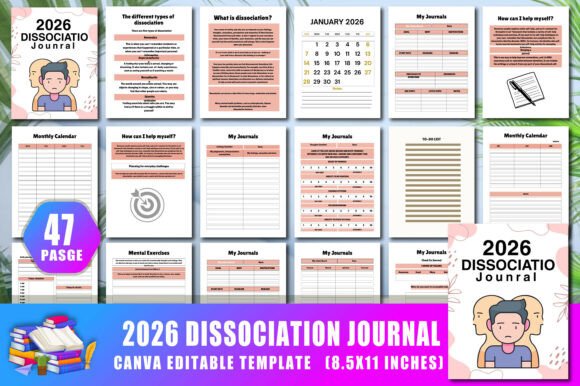
2026 Dissociation Journal: A Practical Tool for Self-Awareness
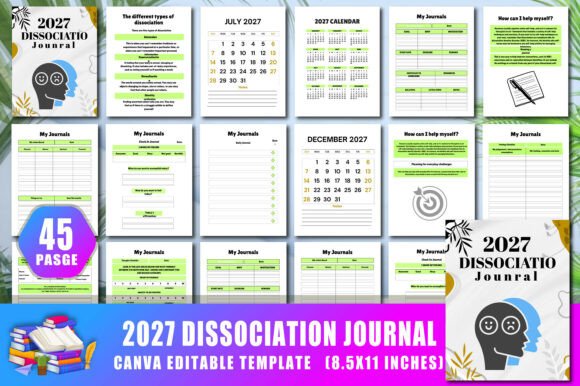
The 2026 Dissociation Journal is more than a guided notebook — it is a structured companion for anyone navigating the complex experience of dissociation. Designed for adults seeking clarity, self-regulation, and creative expression, this 47-page resource combines monthly calendars, weekly planners, therapeutic exercises, and reflective prompts into a single print-ready file. Whether you are a therapist looking for a client handout, a creator building a product for Amazon KDP, or an individual documenting your own journey, this journal offers a grounded framework that balances emotional safety with practical structure. Its clean Canva interior allows instant customization, making it accessible for personal use or professional publishing.
What makes the 2026 Dissociation Journal stand out is its thoughtful integration of psychoeducation with daily planning tools. You are not just recording symptoms — you are building a habit of awareness that supports grounding, emotional regulation, and self-compassion. The journal does not assume a clinical diagnosis; instead, it invites users to explore dissociation at their own pace, using exercises that are evidence-informed and easy to follow.
What Makes the 2026 Dissociation Journal Unique
Unlike generic planners or symptom trackers, this journal is built around a clear intention: to help users understand and manage dissociation in a way that feels actionable, not overwhelming. The layout includes a Belongs to Page for personal ownership, a 2026 Calendar for year-at-a-glance orientation, and monthly spreads from January through December 2026. Each month is paired with journaling space that encourages reflection on dissociation-related experiences, triggers, and grounding successes.
The journal also features dedicated sections on What Is Dissociation, Signs and Symptoms, The Different Types of Dissociation, and Effects of a Dissociative Disorder. These pages are written in accessible language, providing psychoeducation that validates the reader's experience without pathologizing it. For therapists and educators, these sections serve as a conversation starter or a handout that demystifies dissociation for clients or students.
The file is delivered as a high-quality print-ready PDF at 300 DPI with no bleed, which means you can upload it directly to Amazon KDP or edit it in Canva before printing. The design is clean and minimal, with room to add colors, shapes, or personal branding. This flexibility makes it ideal for publishers, small business owners, and creators who want to offer a dissociation resource that feels professional and intentional.
Understanding Dissociation Through Guided Exercises
The core of the 2026 Dissociation Journal lies in its exercise pages, which are designed to gradually build self-awareness and grounding skills. The How Can I Help Myself sections appear multiple times throughout the journal, each time focusing on a different coping strategy. One version introduces the 5-4-3-2-1 Technique, a classic grounding exercise that uses the five senses to anchor the user in the present moment. Another version explores the Categories Exercise, which helps redirect attention by naming items in a category (such as animals, colors, or countries).
The Body Awareness exercise encourages users to scan physical sensations without judgment, while the Mental Exercises sections (repeated across several pages) offer cognitive grounding tasks like visualization, counting, or memory recall. These exercises are not random — they follow a sequence that builds from simple sensory anchoring to more complex cognitive engagement, giving users a toolkit they can adapt to different dissociative experiences.
For someone experiencing depersonalization or derealization, these exercises provide a tangible way to reconnect with the body and environment. The journal does not promise a cure, but it offers a consistent practice that can reduce the intensity and frequency of dissociative episodes over time. The repeated structure of the exercise pages also creates a rhythm, which itself can be grounding for users who thrive on routine.
Creative Ways to Use the Journal for Different Goals
The versatility of the 2026 Dissociation Journal means it can be adapted for multiple contexts. Here are a few practical approaches:
- For individual self-help: Use the journal as a daily grounding companion. Fill in the monthly calendar with therapy appointments, self-care goals, or trigger patterns. The weekly and monthly planner pages help track mood, sleep, and dissociation episodes, creating a data set you can review with your therapist.
- For therapists and counselors: Assign specific exercises as homework between sessions. The psychoeducation pages can be used as handouts during intake or psychoeducation groups. The journal's structure supports progress tracking, and the blank notes pages allow for personalized feedback.
- For educators and workshop facilitators: Incorporate the journal into a psychoeducation curriculum on trauma, dissociation, or emotional regulation. The exercises are simple enough for group settings, and the planner pages help participants integrate learning into daily life.
- For KDP publishers and creators: Use the Canva interior to customize the journal with your own branding, color scheme, or additional prompts. The no-bleed, 300 DPI format ensures high-quality print results, and the 47-page count is manageable for both print-on-demand and short-run printing.
- For hobbyists and small business owners: Offer the journal as a bonus product for clients who work with dissociation, anxiety, or trauma. You can edit the Canva file to include your logo or business information, turning it into a branded resource that adds value to your service.
Each of these applications respects the journal's core purpose while allowing for creative interpretation. The design is intentionally unfussy, so it does not compete with the user's own content. This subtlety is important when dealing with sensitive topics like dissociation, where visual clutter can be distracting or even triggering.
How to Adapt the Journal for Your Audience or Platform
Because the 2026 Dissociation Journal is delivered as a Canva interior, you have full control over its appearance and content. You can change colors, adjust fonts, add shapes, or insert your own illustrations. This is especially useful if you want to tailor the journal for a specific demographic — for example, using softer colors for a calming effect, or adding vibrant accents for a more energetic feel.
If you are publishing on Amazon KDP, the file is ready to upload with no extra formatting required. However, you can also edit it to include a different cover, add a table of contents, or expand the notes section. The 47-page structure is a solid foundation, but you can duplicate or reorder pages to suit your needs. The journal's page count also makes it an affordable print product, which is appealing for price-sensitive markets.
For bloggers, entrepreneurs, or educators who want to offer a free resource to their audience, the journal can be converted into a digital download (PDF) that users can fill in on a tablet or print at home. The no-bleed design ensures that home-printed versions look clean and professional. This can be a lead magnet or a bonus for a course on trauma-informed self-care.
Practical Tips for Getting the Most Out of the Journal
Consistency is the most important factor when using a dissociation journal. Here are a few recommendations:
- Start with the psychoeducation pages. Read through the sections on dissociation types, symptoms, and effects before jumping into the exercises. This builds a shared language between you and the journal, and it validates that what you are experiencing has a name.
- Use the 5-4-3-2-1 technique daily. Even if you are not dissociating at the moment, practicing this exercise daily rewires your brain to respond more quickly when dissociation occurs. Write down your observations in the journal to track progress.
- Pair the monthly calendar with a mood or trigger tracker. Use the calendar pages to note days when dissociation was intense, moderate, or absent. Over time, you may identify patterns related to stress, sleep, or social situations.
- Do not skip the bucket list and vision board pages. These sections may seem unrelated to dissociation, but they serve a therapeutic purpose: they remind you that life includes pleasure, goals, and hope, not just management of symptoms.
- Review your notes with a professional. If you are working with a therapist, bring the journal to sessions. The data you collect can inform treatment decisions and highlight progress that might otherwise go unnoticed.
Keeping the journal organized is easy with the included Planner, Weekly Planner, and Monthly Calendar pages. You can also use the To-Do List and Notes sections for practical tasks like scheduling appointments or recording questions for your therapist. The Vision Board page is a creative outlet where you can paste images, draw, or write affirmations that represent your preferred future — a practice that supports motivation and hope.
Who Can Benefit from the 2026 Dissociation Journal
This journal is designed for adults aged 20 to 50 who are looking for a structured yet flexible tool to address dissociation. The primary audience includes:
- Individuals who experience dissociative symptoms and want a private, self-paced way to build grounding skills.
- Therapists, counselors, and social workers who need a reliable resource to recommend to clients.
- Educators and workshop leaders teaching about trauma, dissociation, or emotional regulation.
- Creators, publishers, and small business owners who want to publish or sell a dissociation-related product on Amazon KDP.
- Hobbyists and entrepreneurs looking for a customizable Canva template they can rebrand for their own audience.
The journal is also suitable for people who are simply curious about dissociation and want to learn more in a structured way. Its tone is educational without being clinical, and its exercises are gentle enough for someone who is new to grounding practices.
In a world where mental health resources are often either too vague or too clinical, the 2026 Dissociation Journal occupies a useful middle ground. It provides clear, actionable content while remaining open to personal interpretation. For anyone who has felt disconnected from themselves or their environment, this journal offers a path back to presence — one page at a time.