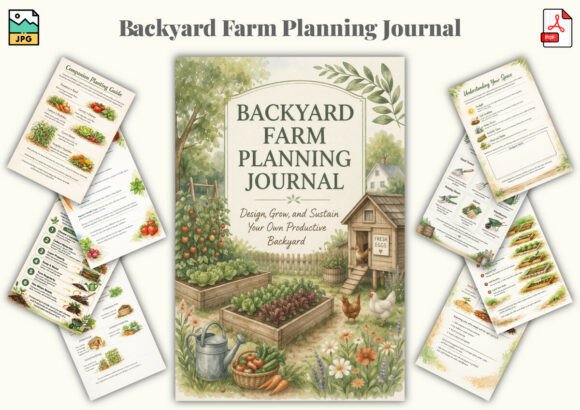
Backyard Farm Planning Journal
There is a moment that many backyard farmers remember clearly: standing in the middle of a garden patch, trowel in hand, a stack of seed packets on the table, and a vague swirl of ideas about what to plant where. That moment can be exciting, but it can also be overwhelming. The Backyard Farm Planning Journal is designed for exactly that moment and for every decision that follows. It is a companion for anyone who wants to move from scattered ideas to a coherent plan, from guessing to tracking, and from hoping for a good harvest to actually learning from each season.
Think of it not as a set of rigid instructions, but as a flexible framework. Whether you are turning a small suburban lot into a vegetable haven, managing a few raised beds on a balcony, or expanding a larger homestead, this journal offers space to think, sketch, record, and reflect. The goal is to help you make decisions based on what happened last season, not on what you hope might happen this time.
When ambition meets reality: the beginner’s journey
Starting out in backyard farming is full of surprises. You might plant tomatoes too early, only to watch them sulk through a late frost. You might overwater carrots and end up with a muddy mess. Or you might plant a whole row of zucchini and realize too late that one plant is enough to feed a neighborhood. A beginner needs structure, but not a rigid rulebook. This is where the Backyard Farm Planning Journal becomes most useful.
The Vision and Goal Planning pages give a first-time grower a place to think about what they actually want. Is the priority fresh salad greens every week? Saving money on groceries? Teaching kids where food comes from? Once that is clear, the Garden Layout Space Design pages help translate that vision into a real-world map. Instead of buying twenty different seed packets on impulse, the beginner can sketch out the available space, measure the sun exposure, and decide what fits realistically.
Another common scenario is the disappointment of forgotten plantings. A beginner might start strong in spring, only to lose track of what was planted where by midsummer. The Crop Planning and Rotation Logs in this journal prevent that scramble. You can mark exactly which bed got the tomatoes last year and which got the beans, so rotation actually happens. And when something fails, the Observation and Reflection pages give you a safe place to ask: what was different about that spot? Did it get enough water? Was the soil too compact? That honest reflection turns a failure into a lesson for the next season.
Urban farmers and small-space growers
Growing food in a city comes with a unique set of constraints. Space is limited, soil quality is often questionable, and you might be dealing with container gardening or a community plot rather than open ground. The Backyard Farm Planning Journal works well here because it is not built around the assumption of acreage. The layout and tracking pages are flexible enough to map out a few containers on a balcony or a narrow strip along a fence line.
An urban farmer might rely heavily on the Watering and Maintenance Trackers. In small spaces, every plant is visible, and every watering mistake shows up fast. A container of basil that dries out for just one hot afternoon might never fully recover. Tracking watering schedules, noting rainfall, and recording when you last fertilized becomes practical data, not busywork. The journal also supports the reality of urban farming: you might only have a few hours on weekends to tend things. The Progress Tracking sections help you see, at a glance, what tasks are waiting and what can wait another week.
One real-world example is a gardener who uses a small rooftop to grow tomatoes, peppers, and herbs. By using the Seasonal Planting Schedules, they learned that their growing season was actually a few weeks shorter than the official zone map suggested, because the rooftop wind dried out plants faster. That observation was recorded, and the next year, they started seeds indoors earlier and chose more wind-tolerant varieties. Small adjustments like that come from consistent tracking, not guesswork.
The experienced homesteader who wants to scale smarter
Those who have been growing food for several years often reach a point where memory alone is not enough. You might recall that the squash did well two years ago, but did you plant it in the south bed or the east bed? Did you add compost or just topsoil? The Backyard Farm Planning Journal becomes a personal archive of that kind of detail. For the experienced grower, the real value is in the rotation logs and observation pages.
When you are managing multiple beds, a chicken coop, and perhaps a small orchard, you need a system that helps you see patterns across time. The Crop Planning and Rotation Logs allow you to track which families of plants went where, over multiple seasons. This prevents the common problem of planting tomatoes in the same spot three years in a row, which invites soil-borne diseases. The Livestock Care Notes are another feature that becomes more valuable as the homestead expands. Recording feed changes, health issues, and egg production helps you notice when something is off before it becomes a crisis.
Consider a homesteader who keeps a small flock of hens and rotates them through the garden beds after harvest. Without a journal, it is easy to forget which bed the chickens finished last week and which one still needs a few days of weeding. The journal keeps that logistics straight. And when you notice that egg production drops every August, you can look back at your notes and see if it correlates with heat stress, molt timing, or a change in feed. That kind of insight is hard to gain from memory alone.
Families and shared gardens
When more than one person is involved in a garden, communication becomes part of the challenge. A family might have one person who loves planning and another who loves planting but hates keeping records. The Backyard Farm Planning Journal can act as a central reference point that everyone can look at. The simple, minimal design means it does not feel like homework. A parent can sit down with kids and use the Vision and Goal Planning pages to decide together what to grow. Kids can draw their own versions of the layout, and everyone can check the Watering Tracker to see if the garden was watered today.
In a shared community garden, the journal can be used by a small group to plan shared beds and divide tasks. The clear layout helps avoid misunderstandings about who planted what and where. If a volunteer planted kale in a bed that was supposed to be reserved for fall carrots, the journal catches that early. Over time, the group builds a shared history of what works in that particular space, which becomes more valuable than any generic gardening book.
Considerations before using this journal
No tool is perfect for everyone, and the Backyard Farm Planning Journal has a few qualities worth considering before you decide if it fits your style. First, it is designed for people who want to write things down. If you prefer digital planning or you never look back at past notes, you might need to build a habit of opening the journal regularly. The pages work best when used as a cycle: plan, record, reflect, adjust. Skipping the reflection part reduces the long-term benefit.
Another consideration is the scale of your operation. With 25 unique pages and a 6x9 inch format, this journal is ideal for a small to medium backyard farm or garden. If you are managing multiple acres or a commercial operation, you might outgrow the space for detailed logs. That said, it can still serve as a seasonal overview, with more detailed records kept elsewhere. Some users find that the compact size makes it easy to carry out to the garden, which encourages more consistent note-taking.
The journal also assumes that you have some basic understanding of gardening concepts like crop rotation and planting zones. While the layout guides you through these ideas, it does not explain them in depth. Beginners may need to pair it with a reference book or online resources to fully benefit from the rotation logs and seasonal schedules. This is not a weakness, it is simply a design choice: the journal prioritizes action and record-keeping over instruction.
One strength worth highlighting is the visual clarity. The pages are clean and uncluttered, with enough room to write but not so much that you feel pressured to fill every line. This reduces the common barrier where people abandon a journal because it feels too demanding. You can use it loosely, skipping sections that do not apply to your current season, and it still holds together as a useful tool.
Practical observations from regular use
People who stick with using a planning journal often share a few observations. One is that the first season of using it feels messy. You might forget to record something, or you might realize halfway through summer that you wish you had tracked a different detail. That is normal. The journal is not a test; it is a tool that improves as you adapt it to your own needs. By the second season, you will start to see patterns in your own notes that surprise you. Maybe you will discover that your soil drains faster than you thought, or that a certain vegetable variety consistently outproduces others in your specific microclimate.
Another observation is that the journal helps with motivation during the slower months. When winter comes and the garden is dormant, flipping through the pages of past seasons reminds you of what worked and what did not. That quiet reflection often sparks new ideas for the coming year. The reflection pages are not just for recording failures; they are also for celebrating successes. Noting that the carrots were especially sweet this year, or that the new trellis system saved space and looked beautiful, gives you something to look forward to when planning starts again.
For those who keep livestock, the Livestock Care Notes section becomes a quick reference during vet visits or when troubleshooting a health issue. Being able to say, “The pullets started laying on this date, and here is when we switched feed,” is more helpful than relying on memory. It also helps with budgeting, because you can track how much feed you used over a season and plan your purchases more accurately next time.
The seasonal planting schedules are another feature that experienced users appreciate. Even if you already know your frost dates, seeing them in a structured schedule alongside your crop choices helps you avoid the common mistake of planting everything at once. You can plan successions: plant a round of lettuce, then replace it with beans, then follow with a fall crop of spinach. The journal encourages that kind of layered thinking, which is the hallmark of a productive small farm.
Ultimately, the Backyard Farm Planning Journal earns its place on the shelf not because it does something revolutionary, but because it does something that many growers need: it gives scattered ideas a home. It turns vague intentions into a written plan. It makes the invisible visible. And it offers a quiet place to learn from your own experience, which is the best teacher of all.
Whether you are plotting out a single raised bed of salad greens, managing a diverse urban garden, or expanding a homestead one season at a time, this journal can adapt to your reality. It is small enough to carry with you, spacious enough to hold a season of memories, and structured enough to keep you honest about what you actually did versus what you meant to do. And in the messy, rewarding world of backyard farming, that honest reflection is what helps you grow next year a little wiser than you were this year.