Kids Adventure Question Planner: A Creative Thinking Journal
Every parent, educator, or content creator knows the challenge of keeping a child genuinely engaged. Screens compete for attention, structured activities feel like school, and open-ended play sometimes lacks direction. The Kids Adventure Question Planner sits in a sweet spot between guided learning and free imagination. It is not another workbook with fill-in-the-blank boredom. It is a journal that presents children with real scenarios—getting lost in a jungle, meeting an alien, solving a mystery—and asks them what they would do next.
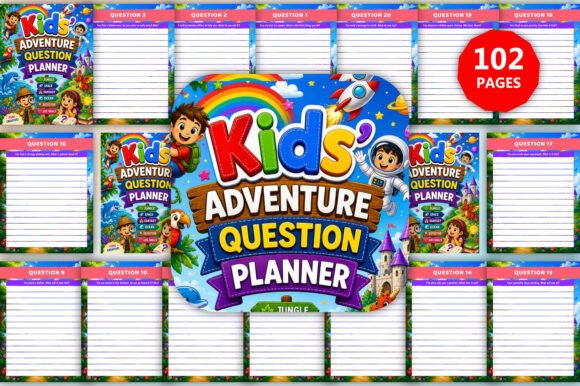
Designed for kids roughly between ages six and twelve, this planner feels like a game rather than an assignment. The pages are colorful without being overwhelming, with space for drawings, short written answers, and even maps or diagrams if the mood strikes. Each theme—jungle, space, fantasy, ocean, detective, and life skills—offers a different kind of challenge. A child might navigate a crashed spaceship one day and plan a treasure hunt the next. The result is a tool that builds confidence, writing ability, and critical thinking without ever feeling like homework.
What Makes This Planner Different from a Standard Activity Book
Most activity books for kids rely on puzzles, mazes, or simple prompts like "what is your favorite animal." The Kids Adventure Question Planner goes deeper. It presents open-ended situations where there is no single correct answer. "You are lost in a jungle and find a strange fruit. Do you eat it? Why or why not?" That kind of prompt forces a child to weigh risk, recall what they know about survival, and articulate a reasoning process. It is essentially a decision-making simulator disguised as a journal.
The visual design supports this thinking. Pages use a mix of bold headings, illustrated borders, and plenty of blank space. There is no cramped layout that intimidates a reluctant writer. Instead, the planner invites participation through its friendly, uncluttered aesthetic. The illustrations are playful but not childish—a distinction that matters for older kids who still enjoy imaginative play but want to feel mature. This balance makes the journal feel like a personal adventure log rather than a babyish coloring book.
For parents and educators, the structure is a relief. You do not need to prep materials or come up with prompts on the fly. Each spread offers a complete micro-adventure. Open the book, pick a page, and the child is immersed within seconds. That low barrier to entry is critical for busy households and classrooms where time is fragmented.
Where This Journal Shines Across Different Settings
The Kids Adventure Question Planner works well in multiple contexts, which is why it appeals to a broad adult audience—from teachers to content creators to small business owners building educational products.
In a classroom, it functions as a morning warm-up or a choice activity for early finishers. Teachers can use the prompts to spark discussion or as the basis for a writing assignment. The life skills theme, for example, includes scenarios about sharing, handling disappointment, and making ethical choices. These align naturally with social-emotional learning goals without feeling preachy.
For homeschooling families, the planner provides a consistent framework for creative writing, critical thinking, and even geography or science when a child wants to research more about jungles, space, or ocean environments. It is flexible enough to use once a week or daily, depending on the family's rhythm.
Content creators and bloggers in the parenting or education space will find the Kids Adventure Question Planner a rich source for reviews, activity ideas, and printable extensions. Its multi-theme structure means you can build a blog series around each theme—space week, detective week, fantasy week—and offer complementary resources. The product's visual appeal photographs well, making it suitable for social media graphics, Pinterest pins, and unboxing or flip-through videos.
Small business owners who create digital or printed educational materials can study this planner as a model of thoughtful product design. The way it balances structured prompts with open-ended expression, uses kid-friendly but not condescending language, and organizes themes into reusable sections offers practical lessons for anyone developing content for children.
How the Design Supports Readability and Engagement
The Kids Adventure Question Planner uses a mix of type styles to create visual hierarchy without confusing young readers. Headings are bold and slightly playful—think rounded sans serif or a friendly handwritten font that signals fun. Body text is clean, readable, and set at a comfortable size for children who are still building reading stamina. Key words are sometimes emphasized with color or a different weight, guiding the child's eye to the core question or action prompt.
This typographic approach matters because a child's willingness to engage drops sharply if text feels dense or intimidating. The planner avoids long paragraphs. Instead, questions are broken into short lines, often with bullet-style formatting that makes the task feel manageable. White space is used generously, giving children room to breathe and room to write or draw.
For adults evaluating this product, the design choices reflect an understanding of how children process information. The visual hierarchy is clear: adventure title, scenario setup, question or prompt, and space for response. A child never has to hunt for what to do next. That intuitive flow is harder to achieve than it looks and is one reason the planner feels seamless in use.
Practical Guidance for Choosing and Using This Planner
If you are considering the Kids Adventure Question Planner for your own child, classroom, or content, a few practical points are worth considering.
First, think about the child's reading and writing level. The planner is marketed for ages six to twelve, but a six-year-old may need help reading some prompts aloud. That is not a problem—it becomes a shared activity. Older kids, especially those who enjoy writing and drawing, will likely work through pages independently and may even revisit favorites. The life skills and detective themes tend to resonate with older children because the scenarios feel more mature.
Second, consider how you will use the completed pages. Some families keep the journal intact as a keepsake. Others tear out pages to display or include in portfolios. The binding is designed to lie flat, which makes writing and drawing comfortable whether the book is on a desk or a lap.
Third, if you are a publisher or content creator reviewing the planner, pay attention to the tone. The language is encouraging without being saccharine. Prompts use "you" directly, placing the child at the center of the adventure. There is no judgment built into the questions. "What would you do?" is a neutral invitation, not a test. That subtlety is important for maintaining engagement across different personality types—confident kids and hesitant kids alike feel safe responding.
Fourth, think about extensions. The planner naturally leads to other activities. A child who loves the ocean theme might want to research real sea creatures. A detective-themed page might inspire a homemade scavenger hunt. Parents and educators can use the prompts as springboards for deeper projects without needing additional curriculum materials.
Finally, consider the commercial licensing if you plan to feature the planner in a product roundup, giveaway, or educational resource. The standard terms for this type of product typically allow personal and classroom use, but any commercial reproduction or distribution of the content requires separate permission. Always verify the license details before incorporating it into paid offerings.
Why This Planner Builds More Than Writing Skills
The Kids Adventure Question Planner does something that many educational tools miss: it treats a child's imagination as a legitimate problem-solving space. When a child decides whether to explore a cave or climb a tree for a better view, they are practicing risk assessment. When they describe an alien encounter, they are practicing narrative structure. When they weigh which clues matter in a mystery, they are practicing logical reasoning.
These are not soft skills. They are the same cognitive muscles used in science, business, and creative work. The planner simply packages them in a format that feels like play. Over time, a child who regularly engages with this kind of thinking develops more confidence in their own judgment. They learn that their ideas have value and that there is often more than one right answer.
For adults who work with children—parents, teachers, therapists, content creators—this journal offers a window into how a child thinks. The responses can be surprising, funny, and revealing. Many parents report learning something new about their child's personality by reading their answers. That alone makes the planner worth the modest investment.
A Few Observations from Real Use
After watching several children use the Kids Adventure Question Planner, a few patterns emerge. Kids almost always want to start with the space theme. Aliens and spaceships have universal appeal. The jungle theme is a close second, especially when animals are involved. The detective theme requires a bit more focus and tends to work better for kids who already enjoy puzzles or mystery stories.
One child, age nine, filled an entire ocean-themed spread with a map of a fictional island, complete with a volcano and a hidden cove. She then wrote a seven-sentence story about why the treasure was buried there. She had never done that level of extended writing voluntarily before. The prompt was simple—"You find a message in a bottle. What does it say?"—but the open-ended nature gave her permission to go as far as she wanted.
Another child, age seven, struggled with handwriting and typically avoided writing tasks. The planner's drawing-friendly format helped. He would sketch his answer first, then add a sentence or two. Over a few weeks, his written responses grew longer. The combination of visual and verbal expression lowered the barrier for him.
These real-world outcomes matter more than any feature list. The planner earns its keep by actually getting kids to think and create, not just by looking good on a shelf.
Final Thoughts on Fit and Value
The Kids Adventure Question Planner is not a quick-fix for boredom or a passive entertainment device. It asks something of the child—attention, decision-making, imagination—and rewards that effort with a sense of ownership. Each page becomes a small achievement that the child can look back on with pride.
For the adults selecting it, the planner is a practical, well-designed resource that supports multiple goals: writing development, critical thinking, creative confidence, and screen-free engagement. Its multi-theme structure provides variety without fragmentation. Its visual design is welcoming without being distracting. And its tone respects the child as a thinker, not just a learner.
Whether you are a parent looking for a meaningful activity, a teacher building a classroom library of engaging resources, a blogger reviewing tools that actually work, or a publisher studying effective product design, this journal delivers. It is the kind of product that quietly earns its place in a home or classroom because it gets used, not discussed.
And that, ultimately, is the highest compliment for any creative tool made for children.