Exam Revision Planner Study Guide Log for Focused Preparation
Preparing for exams often feels like a race against time. Between reviewing notes, practicing past papers, and managing multiple subjects, it is easy to lose track of what you have covered and what still needs attention. The Exam Revision Planner Study Guide Log offers a structured approach to this challenge, helping you turn scattered study sessions into a coherent preparation plan. Whether you are a student facing finals or a professional pursuing certification, having a clear record of your revision journey can make the difference between feeling overwhelmed and walking into the exam room with confidence.
What makes a revision planner truly useful
At its core, a revision planner is more than just a calendar with dates. It is a system that helps you break down large volumes of material into manageable sessions, track your progress, and identify gaps in your understanding. The Exam Revision Planner Study Guide Log goes a step further by combining a study tracker, academic revision guide, test preparation logbook, and finals revision journal into one cohesive resource. This means you are not simply noting what you studied on a given day, but also recording your confidence level, key concepts reviewed, and areas that require more attention.
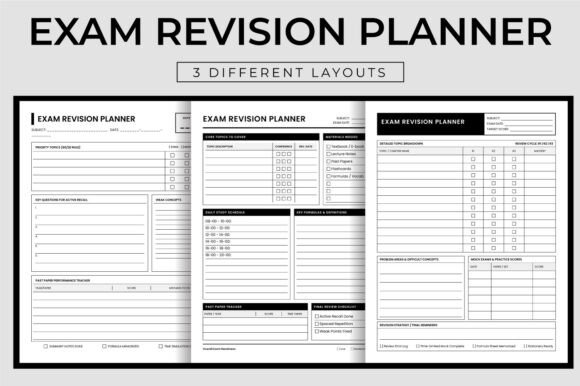
One of the standout features is the inclusion of three different layouts across three PDF files, each 120 pages long. This variety allows you to choose a format that matches your workflow. Some people prefer a daily breakdown with hourly slots, while others respond better to a weekly overview with space for notes. Having options means you can switch between layouts as your study needs evolve. You can also increase or decrease the number of pages if needed, which is practical for shorter preparation periods or intensive revision sprints.
How multiple layouts support different study habits
No two students study exactly the same way. One person might thrive on detailed daily logs that track every hour of focus, while another might prefer a broader weekly view that highlights priority topics. The three layouts in this planner cater to these different preferences without forcing you into a single format.
For example, the first layout might emphasize a structured timetable with dedicated columns for subject, topic, time spent, and mastery level. This works well for those who like clear boundaries and measurable progress. The second layout could focus on a more reflective journal style, where you write short notes after each session about what clicked and what felt unclear. This approach supports deeper learning and helps you spot patterns over time. The third layout might combine both elements, offering a balanced view that includes scheduling, tracking, and reflection in a compact design.
Having these options means you are more likely to stick with the planner throughout your study period. If one layout starts to feel restrictive, you can switch to another without losing your momentum. The three high-resolution PDF files, each at 300 dpi, ensure that every grid, line, and text is crisp and easy to read, whether you print at home or use a professional service.
Practical benefits for students and professionals
The primary audience for a revision planner is anyone who needs to retain and recall information under pressure. Students preparing for final exams, graduate entrance tests, or professional certifications will find the structured format especially helpful. But the tool is not limited to academic settings. Professionals studying for licensing exams, continuing education credits, or skill certifications can also benefit from a system that tracks both time and comprehension.
One of the less obvious benefits is how a revision planner can reduce anxiety. When you have a clear record of what you have studied and what remains, the unknown becomes manageable. Instead of worrying about whether you covered a particular chapter, you can check your log and adjust your focus accordingly. This sense of control is invaluable during high-stakes preparation periods.
Another practical advantage is the ability to review your study patterns over time. By looking back at your entries, you can identify which times of day you are most productive, which subjects require more repetition, and how your confidence grows with each session. This kind of insight allows you to refine your approach as you go, rather than repeating the same habits without improvement.
Who benefits most from a customizable study log
While the planner is designed for general use, certain groups will find it especially valuable. Students who juggle multiple subjects simultaneously need a system that prevents topics from falling through the cracks. The test preparation logbook feature lets you dedicate specific pages to each subject, with space to note key formulas, vocabulary, or concepts you need to revisit.
Adult learners returning to education after a break may appreciate the clear structure that a revision guide provides. When you are out of practice with studying, having a ready-made framework reduces the friction of getting started. Similarly, educators and tutors can use the planner to guide their students through a structured revision schedule, helping them stay on track without constant supervision.
For publishers and small business owners looking at the Amazon KDP market, this product is designed with exactly that platform in mind. The size is 8.5 by 11 inches with no bleed, which is the standard interior size for KDP paperbacks. The files are ready to upload, saving you the time and technical hassle of adjusting margins or resolution. Being customisable also means you can add your own branding, cover design, or additional pages to match a specific niche or audience.
Thoughts on using the planner effectively
Simply having a planner is not enough. Its real value comes from consistent and honest use. Here are a few recommendations based on how people typically get the most out of a revision log.
Start by reviewing the three layouts and choosing one that feels natural for your first week. Use it for a few days, then assess whether it supports your workflow or feels cumbersome. If needed, switch to a different layout for the following week. The ability to choose between formats means you are not locked into a single approach from the start.
Be specific in your entries. Instead of writing studied biology, note the exact chapter or topic, the number of practice problems attempted, and your perceived confidence level. This level of detail makes your log a useful reference when you later need to decide what to review again.
Use the finals revision journal aspect to record not just what you studied, but how you felt during the session. Noting moments of confusion or clarity helps you adjust your study techniques. For instance, if you consistently struggle with a particular topic after 6 PM, you might schedule it for morning sessions instead.
Limitations and fit considerations
No single tool works perfectly for everyone, and it is worth considering whether a printed PDF planner suits your style. If you prefer digital note-taking or use apps that sync across devices, a physical printout might feel like an extra step. However, many people find that writing by hand improves memory retention compared to typing, so the tactile aspect can be a benefit rather than a limitation.
Another consideration is the page count. At 120 pages per PDF, the planner provides substantial space for extended preparation periods. But if you are studying for a short, intensive exam, you might prefer a condensed version. The ability to increase or decrease the pages addresses this, so you can print only what you need. You might also choose to combine layouts, using one for the first half of your preparation and another for the final weeks.
For KDP publishers, the lack of bleed and the standard trim size make this a straightforward upload. But you should ensure that your cover dimensions match the interior and that you test print a sample before publishing. Customisation options allow you to adjust fonts, colors, or add your own instructions, which can help differentiate your product in a competitive marketplace.
Why this approach supports better results
The real strength of the Exam Revision Planner Study Guide Log lies in its flexibility. By offering three distinct layouts across 120-page PDFs, it acknowledges that effective study is personal. Some people need rigid structure, others need room for reflection, and many need a blend of both. Having all three in one set means you can adapt as your needs change, without purchasing separate products.
For the student or professional using it, the result is a clearer path through dense material. For the KDP publisher, it is a ready-to-upload product that meets platform requirements and offers genuine value to buyers. The high resolution and print-ready format remove technical barriers, so you can focus on content and presentation.
In a world where distractions are constant, having a dedicated tool to plan, track, and review your study progress is a practical investment. It does not promise instant results or shortcuts, but it does give you a reliable system to work with. And over the course of weeks or months, that consistency adds up to deeper understanding and greater confidence when it matters most.