Feelings Emotions Activity Book for Kids: A Practical Evaluation
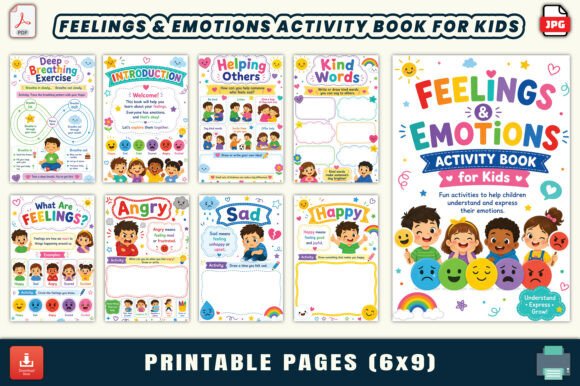
Helping children understand and manage their emotions is a challenge many parents and educators face. Finding resources that are both engaging and educational without requiring extensive preparation is key. The Feelings Emotions Activity Book for Kids is a printable resource designed for children ages 4 to 8. It offers 30 pages of activities focused on emotional recognition, expression, and regulation.
This article evaluates the activity book in a balanced manner. It explores the potential benefits, practical limitations, and specific scenarios where this resource aligns well with developmental goals. The aim is to provide insights that help you decide whether this tool fits your needs for supporting a child’s emotional intelligence.
What the Feelings Emotions Activity Book for Kids Includes
This resource is delivered as a digital download in both JPG and PDF formats. The pages are sized at 6 by 9 inches, making them easy to print at home or at a print shop. Because it is a printable product, you have flexibility in how you use it. You can print individual pages for a specific lesson or compile the entire set into a bound workbook. The 30 pages cover several key areas of social-emotional learning:
- Drawing and coloring activities focused on different emotional states.
- Emotion recognition exercises that help children identify feelings in themselves and others.
- Simple reflection prompts that encourage children to think about their own experiences.
- Calming and breathing exercises designed to support self-regulation.
- Kindness and gratitude pages that promote positive social awareness.
- Creative storytelling prompts that allow children to explore emotions through narrative.
Understanding the structure and content is the first step in evaluating whether this workbook fits your specific context. The mix of creative expression and structured reflection mirrors approaches used in many school-based social-emotional learning programs.
Benefits and Practical Tradeoffs
Any resource has strengths and limitations. A clear-eyed view of both helps you decide if it aligns with your goals.
Advantages of This Resource
One notable strength is the low barrier to entry. The Feelings Emotions Activity Book for Kids requires no preparation. An adult can open the file, print a page, and use it within minutes. For busy teachers, therapists, and parents, this convenience is a significant benefit. The variety of activities also supports different learning styles. Some children express themselves best through drawing, while others benefit from reflection prompts or physical breathing exercises. Having multiple approaches in one resource reduces the need to gather materials from different sources. Additionally, the tangible nature of a printed page gives children a concrete focus during discussions about abstract emotional concepts.
Considerations and Limitations
The printable format does come with tradeoffs. You need access to a printer and ink. For those who prefer a finished, bound book, the responsibility of printing and assembling the pages falls on you. The cost of color printing can also add up, especially if you plan to use the workbook with multiple children or groups.
Another factor to consider is the static nature of worksheet-based activities. While the prompts are thoughtful, they cannot adapt in real-time to a child’s specific mood or social context the way a conversation or an interactive digital tool can. There is also a risk that the workbook becomes a routine task rather than a genuine emotional exploration if it is not paired with guided discussion. Finally, the target age range of 4 to 8 years is specific. A mature 4-year-old may find some activities engaging, while an 8-year-old who needs foundational support can benefit. However, children older than 8 or younger than 4 may not find the format well-suited to their developmental stage.
Evaluating the Core Activities
Looking closely at the types of activities provides a clearer picture of practical utility.
Drawing and Coloring Emotions
For young children or those who have difficulty articulating their feelings verbally, drawing is a powerful outlet. It bypasses the need for complex vocabulary and allows for non-verbal expression. The limitation is that these pages require art supplies. Without crayons, markers, or colored pencils, the interactive value of the page is reduced. This is worth considering if you work in a setting where supplies are limited.
Reflection Prompts and Breathing Exercises
The inclusion of calming and breathing exercises is a practical feature rooted in evidence-based regulation techniques. The Feelings Emotions Activity Book for Kids integrates these directly into the workbook, which is helpful for introducing these concepts in a structured way. However, the effectiveness of a breathing exercise on a page depends heavily on an adult modeling or guiding the child through it initially. A dysregulated child may not be able to follow a written prompt independently. The reflection prompts are simple and open-ended, which is good for encouraging conversation, but they may require an adult to read and discuss them with younger children.
Kindness, Gratitude, and Storytelling Pages
Activities focused on kindness and gratitude shift attention from internal emotional states to external social interactions. This helps children connect their feelings to how they treat others. The storytelling prompts encourage narrative thinking, which supports cognitive development and empathy. A consideration here is that these activities often require reading and writing skills. Younger children in the 4-to-5 age range will need adult assistance to complete them, which reduces opportunities for independent use.
Ideal Use Cases for This Workbook
This resource tends to work best in structured environments where a child already has some baseline stability and support.
- Classroom settings: Teachers can use it as a consistent warm-up activity during morning meetings or as part of a calm-down corner. The no-prep format makes it easy to implement regularly.
- Homeschooling families: Parents who integrate emotional intelligence into their weekly schedule will find the structured pages useful for guiding discussions.
- Therapy sessions: Counselors and therapists can use individual pages as homework between sessions to reinforce concepts. The tangible format gives children something to bring back and discuss.
- Screen-free quiet time: Parents looking for offline activities for car rides, waiting rooms, or quiet time will appreciate that the pages combine engagement with developmental value.
In these contexts, the structured and predictable nature of the workbook is an asset. It provides a reliable framework that both the adult and child can depend on without needing to invent activities from scratch each time.
When Alternatives May Be Worth Considering
No single resource fits every situation. There are scenarios where other approaches might serve a child better.
- Resistance to worksheets: If a child is highly resistant to paper-based activities, digital apps, role-playing games, or building with blocks while discussing feelings may be more effective. The workbook format may feel like schoolwork, which some children resist during emotional conversations.
- Deep therapeutic needs: For children experiencing significant emotional or behavioral challenges, a workbook is a supplement, not a replacement for professional support. It cannot provide the real-time, adaptive guidance that a trained therapist offers.
- Budget constraints: If you have a very limited budget and need a resource that can be used repeatedly without additional printing costs, a single physical book or a set of sturdy flashcards may offer better long-term value.
- High-energy or kinesthetic learners: Children who learn best through movement may struggle to sit and complete worksheet activities. Active games, yoga, or physical movement-based regulation strategies may be a better fit.
- Durability needs: Printed pages are less durable than board books or laminated resources. If the material needs to withstand rough handling over several years, a physical bound book might be a more practical choice.
Alternatives worth exploring include interactive emotional regulation apps, feelings flashcards, classic children’s literature focused on emotions, and conversation-based games. Each has its own set of tradeoffs.
Practical Decision-Making Insights
To determine if the Feelings Emotions Activity Book for Kids aligns with your goals, consider these practical points:
- Assess the child’s engagement style. Do they enjoy drawing, quiet reflection, and structured activities? If so, this workbook is likely a good fit. If they prefer high-energy interaction and movement, you may need to supplement the workbook with active games or conversations.
- Evaluate your own capacity for follow-through. The value of this resource increases significantly when an adult reviews the pages with the child. The discussion around the worksheet is where much of the learning solidifies. If you have limited time for one-on-one interaction, the workbook may be less effective.
- Think about pacing. Because it is a printable, you can use one page per week over the course of 30 weeks. This pacing allows for deep reflection. Alternatively, you can use several pages per week for a more intensive unit. The format gives you control over the schedule.
- Consider the context of use. Will the child use it independently, or will you guide them through it? For independent use, younger children may need pages that rely more on drawing and less on reading. For guided use, the reflection prompts and storytelling pages offer excellent conversation starters.
- Weigh digital versus physical preferences. If you prefer a finished product that requires no assembly, a traditional published workbook may be better. If you want the flexibility to print specific pages multiple times, customize the order, or use individual pages as needed, the digital format is advantageous.
Viewing this workbook as a tool within a larger emotional learning strategy is more effective than seeing it as a standalone solution. It works best when paired with consistent adult support, open-ended conversation, and real-world practice of the skills it teaches.
The Feelings Emotions Activity Book for Kids offers a structured and accessible approach to early emotional education. Its strengths lie in its no-prep format, variety of activities, and flexibility of use. Its limitations include dependence on printing and the static nature of worksheet-based learning. For parents, teachers, and therapists seeking a concrete, screen-free tool to support emotional vocabulary and regulation in children aged 4 to 8, it is a practical option worth considering. When used as a starting point for guided discussion and practice, it can be a meaningful addition to a child’s social-emotional development journey.