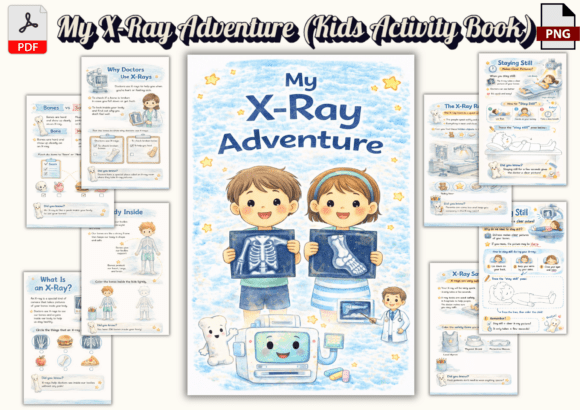
My X-Ray Adventure Kids Activity Book: Less Fear, More Fun at the Doctor
A trip to the hospital for an X-ray can feel daunting for a young child. The unfamiliar machines, the clinical setting, and the need to stay perfectly still often lead to anxiety for both kids and parents. My X-Ray Adventure Kids Activity Book tackles this challenge head-on, transforming a potentially stressful medical visit into a calm, educational, and even enjoyable experience. This beautifully illustrated watercolor activity book is designed for children ages 3 to 8, offering a gentle introduction to what happens during an X-ray in a way that feels safe and playful.
Instead of focusing on the procedure's clinical aspects, the book frames the experience as a learning journey. It uses simple, child-friendly language and engaging activities like matching, coloring, tracing, and sequencing to demystify the process. The emotional support pages are particularly valuable, helping children identify and manage their feelings, building a sense of bravery and control. For parents, educators, and healthcare providers, this isn't just a coloring book—it's a practical tool for reducing fear and fostering early health literacy.
18 Engaging Pages That Build Understanding
The book's structure is its greatest strength. With 18 full-color, watercolor-style pages, it's compact enough for a waiting room or a carry-on bag, yet comprehensive enough to cover the entire X-ray journey. The content moves from explaining what an X-ray machine is and how it works, to showing what happens in the room, and finally to helping kids understand why staying still is important. Activities like matching body parts to X-ray images make abstract concepts concrete, while tracing exercises help develop fine motor skills in a relaxed, non-medical context.
For creators and educators, this format offers a powerful template. You can adapt similar narrative-driven activity books for other medical procedures, such as getting a cast, having an MRI, or visiting the dentist. The key is using a consistent visual style—in this case, gentle watercolors—that feels comforting rather than clinical. The emotional support pages, which might include breathing exercises or affirmation prompts, are a smart addition that can be replicated in any health-related content for young children.
Adapting the Book for Different Audiences and Platforms
While the print version is ideal for hands-on use, the digital formats (PDF and PNG) open up a wide range of creative possibilities. A pediatrician's office could display pages on a tablet in the waiting room, or send the PDF to families before a scheduled X-ray appointment. Teachers can project pages on a smartboard for a classroom health lesson, while homeschoolers can print individual activities to complement science units on the human body.
For digital content creators, the PNG files allow for straightforward integration into blog posts, social media graphics, or educational videos. Imagine a short Instagram Reel showing a child coloring the sequencing activity, or a blog post that walks parents through the book's features with annotated screenshots. The 6 x 9 inch page size is also perfect for planners or mini-books, making it easy to create a series of small, focused activity books on different health topics.
Practical Variations for Different Goals
The core concept of My X-Ray Adventure Kids Activity Book can be adapted for different goals without losing its effectiveness. For a parent preparing a child who is extremely anxious, you might focus solely on the emotional support pages, using them as a conversation starter days before the appointment. For a classroom setting, the sequencing and matching activities become a collaborative puzzle, where students work together to arrange the steps of an X-ray visit.
Entrepreneurs and small business owners in the educational space can use this as a case study. The book demonstrates a clear need (reducing medical anxiety) and delivers a focused solution (a themed activity book). If you're creating similar content, consider pairing your book with a complementary digital resource—such as a short animated video or a printable social story—to create a more comprehensive toolkit. This layered approach adds value and increases the likelihood of the resource being shared within parenting groups or educational networks.
Why Parents and Educators Value This Approach
Feedback from parents and educators consistently highlights the book's role in opening communication. A child who is coloring an X-ray machine while talking about what it does is far more likely to express their fears than one who is simply told to be brave. The book normalizes the experience, showing that many children have X-rays and that the process is routine and safe. This aligns perfectly with the principles of social-emotional learning (SEL), where understanding and managing emotions is as important as acquiring academic knowledge.
From a marketing perspective, emphasizing the combination of creativity and education is smart. The watercolor illustrations feel warm and artistic, setting the book apart from clinical, cartoonish medical materials. This aesthetic appeals to parents who value gentle, beautiful design in their children's resources. For bloggers and publishers, reviewing or recommending this book offers a way to provide genuinely useful content to an audience actively seeking solutions for a common parenting challenge.
Keeping Content Organized and Audience-Friendly
When developing resources like this, organization is crucial. The book's clear progression from introduction to activity to emotional support creates a natural flow that children can follow independently or with minimal guidance. For your own projects, whether you're creating a similar activity book or writing an article about one, structure your content to mirror this logic: start with the problem, introduce the solution, explain how it works, and then show how different people can use it.
Consistency in visual language and tone is equally important. The watercolor style isn't just decorative—it signals safety and gentleness. If you were to create a series, maintaining that same visual language across all books would build brand recognition and trust. For a freelancer or designer working with healthcare clients, proposing a consistent art style for patient education materials can be a compelling portfolio piece that demonstrates user-centered design thinking.
Real-World Applications and Recommendations
To get the most out of My X-Ray Adventure Kids Activity Book, plan for its use beyond the single appointment. Incorporate it into a broader health education routine. Use the activities as a springboard for conversations about bones, the skeleton, how doctors help us, and why it's important to take care of our bodies. The sequencing activity, for example, can be extended by asking children to draw their own map of a visit to the hospital.
For creators considering their own projects, the key takeaway is the power of a targeted, empathetic approach. Instead of a generic activity book, this one serves a specific purpose for a specific audience. Identifying other moments of common childhood anxiety—first dentist visit, getting a shot, staying in a hospital—and creating equally focused resources can fill a genuine gap. The combination of practical information, creative engagement, and emotional support is a winning formula that can be applied across many contexts, from print publications to digital learning platforms.
Ultimately, the value of My X-Ray Adventure Kids Activity Book lies in its ability to shift a child's perspective. By making the unknown known and the scary manageable, it empowers children to approach their healthcare experience with curiosity rather than fear. For any adult involved in the care or education of young children, this is a resource that delivers on its promise: making doctor visits easier, calmer, and even a little bit fun.