The Self-Care Journal: A Structured Path to Emotional Resilience and Personal Growth for Modern Professionals
In an era where professional demands, digital distractions, and constant connectivity blur the lines between work and life, the concept of self-care has evolved from a trendy buzzword to an essential practice for sustainable success. For creators, entrepreneurs, marketers, freelancers, and professionals, the challenge is not recognizing the need for self-care, but rather integrating it consistently into an already packed schedule. A Self-Care Journal serves as more than a notebook; it is a structured, practical tool that transforms abstract intentions into daily habits. This article explores why this type of guided journal is resonating deeply with driven individuals, how it aligns with broader shifts in wellness and productivity culture, and how it can become a cornerstone of a sustainable lifestyle.
What Is a Self-Care Journal and Why Does It Matter Now?
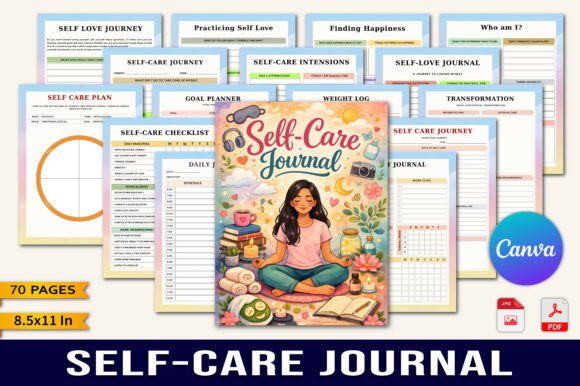
A Self-Care Journal is a thoughtfully designed printable workbook that provides a framework for building healthier habits, practicing mindfulness, and nurturing self-love. It goes beyond simple diary entries by incorporating guided prompts, trackers, and reflection exercises that support emotional balance, personal growth, and daily well-being. For professionals who thrive on structure and efficiency, this format offers a clear roadmap rather than a blank page—making self-care actionable and measurable.
The relevance of such a journal is amplified by several converging trends. The global wellness market continues to expand, with an increasing emphasis on mental health and emotional fitness. According to recent global wellness industry reports, consumers are shifting from reactive health management to proactive well-being. Professionals, in particular, are seeking tools that help them manage stress, prevent burnout, and maintain peak performance without sacrificing mental health. A Self-Care Journal fits squarely into this movement by coupling introspection with practical planning, much like a business strategy document for personal health.
Why Professionals and Creators Are Paying Attention
The audience of professionals, creators, and entrepreneurs is uniquely positioned to benefit from a Self-Care Journal. These individuals often operate in high-pressure environments where the boundary between personal and professional life is thin. Freelancers face inconsistent workloads, marketers juggle campaign deadlines, and entrepreneurs bear the weight of business decisions. The common thread is a need for sustainable energy, emotional regulation, and a sense of control.
What makes the Self-Care Journal particularly compelling is its ability to address both the emotional and logistical aspects of self-care. It includes elements like a Self-Care Checklist, Life Checklist, Goal Planner, and Self-Care Calendar—tools that mirror the productivity systems professionals already use for work projects. This familiar structure lowers the barrier to entry. Instead of feeling like another "soft" activity, self-care is framed as a strategic process: one that involves tracking, reflection, and iterative improvement.
Moreover, the journal's features cater to the growing demand for holistic health. Modern professionals are increasingly recognizing that cognitive performance is tied to emotional well-being. A mood tracker, sleep log, and period tracker (where applicable) provide data points that help identify patterns. For instance, a marketer might notice that her creative output dips during weeks of poor sleep; the journal becomes a diagnostic tool that prompts action. This data-driven approach to self-care resonates with a generation accustomed to tracking steps, calories, and work output.
From Self-Care as a Luxury to a Necessity
The shift in perception around self-care—from a luxury for the privileged few to a necessity for everyone—is especially pronounced among knowledge workers. Burnout has been officially recognized by the World Health Organization as an occupational phenomenon. In response, companies are incorporating wellness programs, but the responsibility for daily practice often falls on the individual. A Self-Care Journal empowers the user to take ownership of their well-being in a concrete way. It addresses the changing expectation that professionals must be proactive about mental health, not just reactive after a crisis.
How the Self-Care Journal Addresses Modern Work-Life Challenges
Modern workflows are characterized by fragmentation: a constant stream of emails, notifications, and meetings that break focus. This environment makes it difficult to cultivate self-awareness and reflection. A Self-Care Journal provides a designated space to pause. The inclusion of a Brain Dump page, for example, is a cognitive offloading technique used by many productivity experts. By writing down intrusive thoughts or to-dos, the professional clears mental clutter, reducing anxiety and improving focus for the task at hand.
Consider the freelancer who juggles multiple clients. Without a structured system, self-care can easily become an afterthought. The journal’s Daily Self-Care Routine and Self-Care Intention pages encourage deliberate commitment at the start of each day. The Goal Planner and Achieve Your Goals sections tie self-care directly to professional ambitions. When a creator sees that rest and mindfulness are part of the path to completing a big project, the value becomes intrinsic. This integration of well-being into goal achievement is a hallmark of the modern self-care movement, moving away from guilt or indulgence toward strategic self-maintenance.
Practical Use Cases Across Different Professions
- Marketers: Can use the Mood Tracker to correlate emotional states with campaign performance. A low-mood week might indicate the need for more delegation or a break before launching a high-stakes project.
- Entrepreneurs: The Life Balance Wheel helps assess distribution of energy across business, family, health, and personal growth—preventing the common trap of business domination.
- Freelancers: The Grocery List and Weight Log might seem mundane, but for someone working from home, maintaining basic routines is vital for mental health. The Self-Care Checklist ensures that even small acts like drinking water or taking a walk are not overlooked.
- Professionals in high-stress roles: 30 Days of Gratitude and Positive Affirmations combat the negativity bias that can arise from constant problem-solving. Self-Talk Support pages help reframe internal dialogues, a critical skill for resilience.
The Role of Mindfulness and Self-Reflection in a Fast-Paced World
Mindfulness has moved from meditation cushions into corporate boardrooms and home offices. Research shows that mindfulness practices can reduce burnout, improve decision-making, and enhance emotional intelligence. A Self-Care Journal incorporates several mindfulness elements, such as the Self-Love Affirmation pages, Self-Love Letter, and Self-Esteem Journal. These prompts encourage non-judgmental self-observation and self-compassion—key components of mindfulness.
The journal’s Understanding Yourself section is particularly valuable for professionals who want to leverage their strengths. By identifying personal strengths and reflecting on acts of kindness (An Acts of Kindness page), the user builds a positive self-concept that buffers against criticism or failure at work. This aligns with the trend of positive psychology applied in workplace settings, where focusing on what works rather than fixing deficits leads to higher engagement and productivity.
Integrating Self-Care with Goal Achievement
One of the most powerful features of a Self-Care Journal is its dual focus on nurturing the self while pursuing goals. Many professionals have experienced the trap of chasing achievements at the expense of health, only to find success hollow. The journal’s structure prevents this by pairing goal planning (Achieve Your Goals, Goal Planner) with wellness tracking (Wellness Goals, Transformation, Weight Log). This mirrors the integrated approach of leading business thinkers: performance is a product of sustainable habits, not relentless hustle.
The Self-Care Journey and Self-Care Ideas sections offer variety and prevent monotony. A professional might use the Self-Care Calendar to plan a monthly hiking trip or a weekly digital detox. The Self-Care Plan and My Desires pages encourage larger-picture thinking: what truly brings fulfillment beyond job titles and revenue? For entrepreneurs who are often consumed by vision, these prompts reconnect them with personal passions that may have been sidelined.
From Printable to Practice: Making Self-Care a Habit
The effectiveness of a Self-Care Journal lies in its ability to create a feedback loop. The Self-Care Tracker and Sleep Tracker provide accountability. Weekly Journal and Daily Journal entries allow for adjustments. Over time, this builds self-awareness. For example, a marketer might notice that her creativity peaks after a session of Self-Talk Support or that her decision-making improves after checking her Mood Tracker and choosing a grounding activity.
The journal also addresses the specific challenge of consistency for busy professionals. Because it is a printable workbook, it can be integrated into existing analog systems—bullet journals, planners, or even carried as a standalone tool. The physical act of writing has been shown to enhance comprehension and commitment compared to digital notes. For hybrid workers, having a dedicated journal creates a ritual that signals the transition from work mode to self-care mode.
Connecting to Larger Developments in Lifestyle and Business
The rise of the Self-Care Journal is not an isolated phenomenon. It reflects a broader cultural shift toward intentionality. In the creator economy, where influencers and solopreneurs rely on their own energy and creativity, burnout is a existential threat. Tools that promote self-care are becoming as essential as project management software. Similarly, in corporate settings, employee wellness programs are increasingly incorporating elements like gratitude journals and habit trackers—similar to what this journal offers.
From a consumer behavior perspective, people are moving away from one-size-fits-all wellness products toward customizable solutions. The Self-Care Journal is modular; users can prioritize the sections that resonate most, whether it’s the Transformation pages or the Self-Love Quiz. This flexibility aligns with the long-tail trend in content and product design: meet specific needs rather than mass-market averages.
Practical Observations for Getting the Most from a Self-Care Journal
- Start with the basics: For professionals new to journaling, begin with the Daily Self-Care Routine and Self-Care Checklist. Consistency over perfection is key.
- Use it as a pre-meeting ritual: Spend two minutes with the Brain Dump or a single affirmation before a board presentation or client meeting. This improves focus and reduces nerves.
- Leverage the goal features: Pair the Goal Planner with your professional targets. Each quarter, use the Transformation pages to review progress holistically—not just revenue but sleep, mood, and relationships.
- Involve your team: If you manage a team, encourage collective use. The Acts of Kindness page can be a team activity to build psychological safety.
- Rotate through sections: The journal is rich with variety. If a week feels stagnant, switch from the Self-Love Journal to the 6 Healthy Habits page to reset.
Conclusion: A Sustainable Tool for a Sustainable Life
The modern professional faces an asymmetry: we are expected to perform at high levels while simultaneously managing unprecedented stress. A Self-Care Journal is not a magic solution, but it is a robust framework for those willing to invest time in their own well-being. By combining emotional exploration with practical trackers, it bridges the gap between aspiration and action. As the lines between work and life continue to blur, having a structured practice to return to—grounded in self-compassion and clarity—becomes not just beneficial, but essential.
For creators, entrepreneurs, marketers, freelancers, and enthusiasts, this journal offers a method to build the resilience required for long-term success. It is a reminder that the most valuable asset any professional has is not their network or their skill set, but their own mind and body. A Self-Care Journal is the tool to maintain that asset, daily.