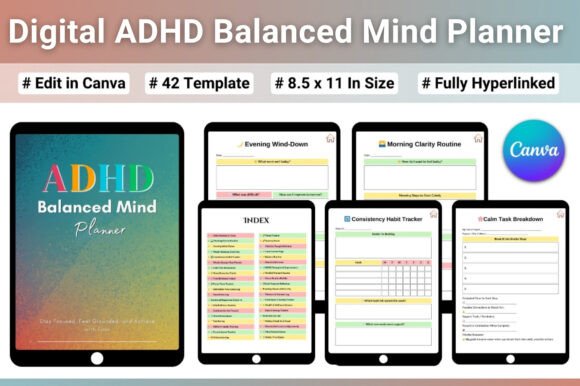
Digital ADHD Balanced Mind Planner
Living with an ADHD brain often means navigating a constant stream of thoughts, tasks, and shifting emotions. Traditional planners, with their rigid layouts and linear structures, can feel like just another source of friction. They demand an executive function that is often already stretched thin. The Digital ADHD Balanced Mind Planner enters this space not as a simple scheduling tool, but as a carefully designed system for mental wellness, focus, and daily structure. It provides a framework for reducing overwhelm without imposing a one-size-fits-all approach to productivity.
A Framework Designed for the ADHD Brain
What sets this planner apart is its foundation in hyperlinked navigation. For someone with ADHD, the time spent searching for the right page or section can be enough to derail a whole planning session. The clickable index allows users to jump instantly to their daily focus page, a distraction log, or a wind-down routine. This immediate access reduces friction and respects the limited bandwidth of executive function. It transforms the planning process from a draining task into a streamlined, supportive check-in.
The 42-page structure is intentionally comprehensive but not overwhelming. It balances the need for visual structure with the flexibility to adapt. Because it is editable in Canva, users are not locked into a static template. A freelancer might simplify the daily layout, while an educator might add more reflection space. This blend of ready-made structure and custom flexibility is key to long-term usefulness.
Speed and Efficiency for the Professional
Professionals, entrepreneurs, and freelancers often juggle multiple revenue streams, client communications, and project deadlines. The ADHD brain can hyperfocus on one task while completely losing track of others. The Daily Focus Clarity System becomes a professional anchor here. The Top 3 Priorities system forces a decision: what truly moves the needle today? This prevents the common trap of mistaking busy work for productive work.
The Focus Timer Tracker and Focus Interval Tracker offer external scaffolding for time. Instead of relying on an internal (and often faulty) clock, professionals can use these tools to structure deep work sessions. A marketer planning a campaign, for example, can set specific intervals for research, drafting, and revision, using the timer to stay within healthy time boundaries. The Distraction Awareness Log helps identify recurring workflow interruptions—like notification checking or context switching—allowing the user to build better systems around their workday.
For the small business owner, the planner offers commercial value by protecting focus. Every hour spent in flow is an hour of high-quality output. The hyperlinked structure ensures that moving from a strategic planning session to a daily task list takes seconds, not minutes. This efficiency directly impacts the bottom line.
Creativity and Clarity for Makers and Marketers
Creators, bloggers, and hobbyists experience ADHD differently. Their challenge is often not a lack of ideas, but an overflow of them. The Brain Dump page is a critical feature for this group. It provides a contained, judgment-free space to capture every concept, headline, or project spark before it gets lost. Once the brain dump is externalized, the natural next step is the Top 3 Priorities system, which helps filter the noise and select a single project to develop.
The Hyperfocus Log is a unique tool for creative professionals. Hyperfocus can be a superpower or a trap. By logging when hyperfocus occurs, what triggered it, and what was produced, a creator can learn to intentionally channel it. A blogger might discover that their best writing happens late at night, while a graphic designer might find that music with a specific tempo triggers flow. This self-awareness is invaluable.
Equally important is the Distraction Awareness Log. For someone in a creative field, distraction can often feel like a failure. This log reframes it as data. It helps identify patterns—like the urge to browse social media when facing a difficult design choice—allowing the user to prepare strategies in advance. This turns the planner from a passive record into an active tool for creative resilience.
Emotional Wellness as a Creative Foundation
The Emotional Mental Wellness pages are not an afterthought; they are central to sustaining creative output. ADHD affects emotional regulation just as much as focus. The Morning Clarity Routine and Evening Wind-Down Reflection provide a gentle structure for checking in with one's emotional state. For a content creator facing algorithm changes or tough feedback, these pages offer a space to process feelings without judgment, preventing emotional spirals from disrupting creative work.
Building Sustainable Routines for Educators and Beginners
For educators and individuals new to structured planning, ease of use is the highest priority. A complex system can feel like another chore. The Digital ADHD Balanced Mind Planner uses a clean, uncluttered design that feels inviting rather than demanding. The Daily Balance Focus Page is the heart of the system, offering a simple check-in on energy levels (morning, midday, evening) alongside task management.
The Morning Clarity Routine helps an educator set an intention before the school day begins, while the Midday Reset Check-In provides a crucial moment to regroup after a packed morning of classes. This is where the planner proves its learning value. It teaches beginners that structure does not have to be rigid. A simple pivot in the afternoon can save the entire day from feeling lost.
For the consumer or hobbyist, the value lies in the Balance Routine Planner. It acknowledges that not every day needs to be optimized for productivity. Some days require rest, creative exploration, or social connection. By integrating these elements into the daily structure, the planner aligns with the natural rhythms of life rather than fighting against them. It helps a hobbyist dedicate time to their craft without guilt, and helps a parent balance personal goals with family needs.
Matching the Planner to Your Personal Workflow
This planner is an excellent fit for someone who:
- Responds well to visual structure and digital interactivity and enjoys or tolerates digital planning on a tablet or iPad.
- Needs flexibility to adapt layouts (Canva editable) without starting from scratch every week.
- Wants a single hub for daily routines, focus work, and emotional reflection, reducing the need for multiple apps or notebooks.
- Struggles with time blindness and needs external timers and interval trackers built into their planning ecosystem.
- Values a tool that acknowledges emotional regulation as a core part of focus and productivity.
It might be less suitable for someone who prefers the tactile feel of paper and does not enjoy screen-based planning. It also may not be the best fit for someone who needs heavy project management features, such as Gantt charts or complex team collaboration tools, as its strength lies in personal clarity and daily structure. Finally, if you are looking for a strictly prescribed curriculum with no room for modification, the flexibility of this planner might feel too open.
A Tool for Continuous Self-Discovery
The true value of this planner unfolds over time. It is not a quick fix, but a practice. The Distraction Awareness Log looks different in week one compared to week ten. The Hyperfocus Log begins to reveal deep patterns about your cognitive strengths. The Energy Check helps you design a life that respects your natural fluctuations in focus and motivation.
For the professional, it is a system for reclaiming time. For the creator, it is a channel for chaos to become clarity. For the educator or beginner, it is a gentle scaffold for building habits that stick. The Digital ADHD Balanced Mind Planner does not promise to fix your brain. Instead, it offers a flexible, intelligent framework that works with your brain, helping you build a calm, productive routine that is uniquely your own.