Fun Science Experiments for Kids That Make Learning Stick
Every child is born a scientist. They ask endless questions, poke at things, mix substances together just to see what happens, and find joy in the smallest discoveries. The trick is channeling that natural curiosity into real learning without losing the excitement. That is exactly what Fun Science Experiments for Kids delivers — a hands-on approach that turns ordinary household items into unforgettable lessons. Whether you are a parent trying to keep the kids engaged on a rainy afternoon, a homeschool teacher looking for structured activities, or a classroom educator seeking fresh ideas, science experiments designed for young minds offer far more than just entertainment.
Why Hands-On Science Matters More Than You Think
There is something almost magical about watching a child's face light up when a baking soda volcano erupts or when a balloon sticks to a wall after being rubbed on their hair. But behind that magic lies serious cognitive development. When children perform experiments themselves, they are not just passively receiving information. They are forming hypotheses, making observations, recording data, and drawing conclusions. These are the same skills used by professional researchers, and building them early creates a foundation for critical thinking that lasts a lifetime.
Printed workbooks that guide kids through Fun Science Experiments for Kids take this experience a step further. Instead of watching a video or reading about a concept, children actively engage with materials, follow structured instructions, and record their findings. This combination of tactile learning and guided reflection helps information move from short-term memory into genuine understanding. The printable format also means you can repeat experiments, share them with siblings or classmates, and build a portfolio of scientific work that grows over time.
What Makes a Great Science Experiment for Children
Not all experiments are created equal, especially when kids are involved. The best Fun Science Experiments for Kids share several key qualities that make them both educational and practical for everyday use.
Accessible Materials
Experiments that require specialty equipment or hard-to-find chemicals quickly become frustrating. The most effective activities rely on items already in your kitchen, laundry room, or bathroom cabinet. Balloons, baking soda, vinegar, paper clips, string, coins, jars, and food coloring are the real stars of children's science. When parents or teachers can open a cupboard and find everything needed, the barrier to learning drops dramatically. The printable workbook mentioned earlier is built around this principle entirely — every experiment uses common household materials, so there is no last-minute scrambling for supplies.
Clear, Child-Friendly Instructions
Young scientists need directions that are easy to follow without constant adult intervention. Step-by-step instructions written in plain language, paired with visual cues, help children work through experiments independently. This builds confidence and reduces the frustration that can derail a learning moment. Good instructions also include safety notes where appropriate, teaching kids that real scientists always prioritize responsible practices.
Built-In Observation and Recording
The difference between a fun activity and a genuine learning experience often comes down to reflection. When children pause to record what they see, measure results, or compare outcomes, they move from simply playing to actually doing science. Observation boxes, data recording spaces, and prompts for drawing or writing about results transform a simple demonstration into a structured investigation. This is where a workbook truly shines — it provides the framework for scientific thinking without feeling like homework.
Exploring the Experiments That Spark Real Curiosity
A well-rounded collection of Fun Science Experiments for Kids should cover multiple scientific disciplines. Physics, chemistry, biology, and engineering all offer unique opportunities for hands-on discovery. Let us walk through some of the standout experiments that demonstrate this range and explore what makes each one valuable.
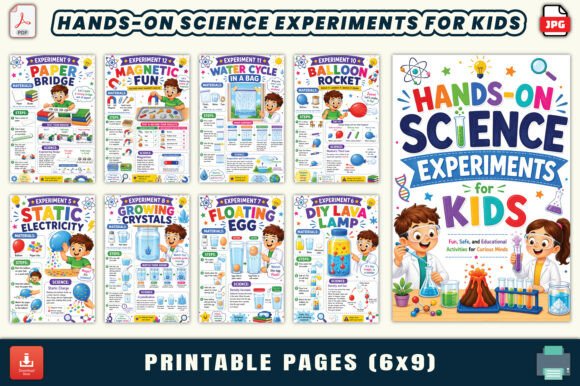
Static Electricity Balloon
Few experiments capture attention as quickly as making hair stand on end or moving lightweight objects without touching them. This experiment introduces the concept of static charge and electron transfer. Children learn that rubbing two materials together can create an imbalance of charges, and they can test which materials produce the strongest effect. The simple observation of a balloon sticking to a wall or making paper jump leads naturally into deeper questions about electricity and forces.
Baking Soda Chemical Reaction
The classic vinegar and baking soda reaction never gets old, but it can be so much more than just a fizzy mess. By varying the amounts of each ingredient, testing temperature effects, or timing the reaction, children begin to understand concepts like chemical change, gas production, and reaction rates. The workbook format encourages them to record their observations and compare different trials, turning a playful eruption into a real scientific investigation.
Density Tower
Layering liquids of different densities creates a visually stunning result that teaches a fundamental physical property. Using honey, dish soap, water, oil, and rubbing alcohol, children can build a tower where each liquid stays in its own layer. This experiment helps them grasp why some objects float and others sink, even if they look similar. It also introduces the idea that density is a measurable property that determines how materials interact.
Lemon Battery Circuit
Proving that fruit can power a small light bulb is an unforgettable lesson in chemistry and electricity. By inserting zinc and copper electrodes into a lemon and connecting them with wires, children complete a circuit that generates a small electric current. This experiment connects abstract concepts like ions, conductors, and circuits to something tangible and tasty. It also opens up discussions about renewable energy sources and how batteries work in everyday devices.
Balloon Rocket Physics
String, a straw, tape, and a balloon are all it takes to demonstrate Newton's Third Law of Motion. When the balloon is released, escaping air propels it along the string, showing that every action has an equal and opposite reaction. Children can experiment with different balloon sizes, shapes, or inflation levels to see how these variables affect speed and distance. This is physics in its purest, most accessible form.
Capillary Action Flower
Placing the stem of a white flower into colored water and watching the petals change color over time is a gentle introduction to how plants transport water. Capillary action draws the liquid upward through tiny tubes inside the stem, and the color eventually reaches the petals. This experiment teaches biology and plant physiology while also providing a beautiful, patient exercise in observation. Children can track the progress over hours or days, recording changes in a data space provided in the workbook.
Paper Bridge Engineering
Engineering challenges encourage creativity, problem-solving, and resilience. The paper bridge experiment asks children to design and build a bridge using only paper and tape that can hold weight. They test different folding techniques, shapes, and reinforcements, learning about structural integrity, load distribution, and compression versus tension. This kind of open-ended investigation is excellent for group settings where children can collaborate, compete, and learn from failed designs without frustration.
Practical Benefits of Using a Printable STEM Workbook
Having a structured collection of Fun Science Experiments for Kids in a printable format provides advantages that go beyond the experiments themselves. Flexibility is one of the biggest draws. You can print individual pages for specific lessons or the entire workbook for a science camp or enrichment program. The ability to reprint pages means that spill-prone activities or enthusiastic repeat attempts do not result in lost work. Teachers can also print multiple copies for classroom use without purchasing separate books for each student.
Screen-free learning is another major benefit in an age where children spend hours staring at displays. A physical workbook that kids can write in, draw on, and flip through engages different cognitive pathways than digital content. The act of writing observations by hand improves retention, and the absence of notifications or distractions allows for deeper focus. Many parents find that the combination of a printed workbook and hands-on materials creates a calm, productive learning environment that feels very different from screen-based education.
Portability is also worth considering. The 6x9 inch size fits easily into a backpack or tote bag, making it simple to bring science learning to parks, libraries, grandparents' houses, or anywhere else inspiration strikes. The high-resolution PDF and individual PNG files provided with this particular workbook mean you can print at home, at a print shop, or even display pages on a tablet if you prefer a hybrid approach. This adaptability suits a wide range of lifestyles and teaching situations.
How This Fits Into Modern Learning Environments
Today's educators and parents are increasingly looking for resources that align with STEM goals while remaining flexible enough to adapt to different schedules and learning styles. The Fun Science Experiments for Kids approach works well in several common scenarios.
Homeschool families often struggle to find science resources that are both rigorous and engaging for multiple age levels. A workbook with varied experiments allows siblings to work together, with older children taking on more detailed recording and younger ones focusing on observation and participation. The clear learning objectives help parents track progress without needing a science background themselves.
Classroom teachers appreciate resources that minimize prep time while maximizing educational value. Having twenty ready-to-go experiments with printable instruction sheets and data recording spaces means less time creating materials and more time facilitating learning. The experiments can be used as stations, whole-class demonstrations, or extension activities for early finishers.
After-school programs and enrichment camps benefit from the structured yet flexible nature of a workbook format. Leaders can pick and choose experiments that fit their theme, schedule, or available supplies. The professional design and clear instructions also make it easy for volunteers or less experienced facilitators to lead activities confidently.
Parents looking for weekend or holiday activities will find that these experiments offer a meaningful alternative to passive entertainment. Instead of reaching for a tablet, children can be invited to investigate, create, and discover. Many parents report that the shared experience of doing science together strengthens family bonds and creates positive memories around learning.
The scientific explanations written in child-friendly language are particularly helpful for adults who may not feel confident explaining concepts like surface tension or evaporation. You do not need a degree in chemistry to guide a child through these experiments. The workbook does the explaining for you, in terms that make sense to young learners without oversimplifying the science.
What to Look for When Choosing Science Experiment Resources
Before committing to any collection of Fun Science Experiments for Kids, there are several factors worth considering. The age range of the intended audience matters greatly. Some experiments are better suited to younger children who are still developing fine motor skills, while others challenge older kids with more complex variables and measurement requirements. A good resource offers variety that spans multiple age groups or clearly indicates which experiments work best for different developmental stages.
The balance between open-ended exploration and structured guidance is another important consideration. Too much structure can stifle creativity, while too little can leave children overwhelmed or unsure what to do. The best resources provide enough scaffolding to build confidence while leaving room for curiosity and variation. Observation questions that ask "What do you notice?" or "How could you change this experiment?" invite deeper thinking without prescribing a single correct answer.
Safety should never be overlooked. While household materials are generally safe, some experiments involve heat, sharp objects, or chemical reactions that require adult supervision. Transparent safety notes and age recommendations help adults make informed decisions about when and how to facilitate activities. The workbook format allows these notes to be included right alongside instructions, so they are not skipped or forgotten.
Finally, consider the long-term value of the resource. A collection of twenty experiments that can be repeated, adapted, and revisited over months or years offers far more value than a one-time activity book. Printable formats excel in this regard, since you can reprint favorite experiments or share them with friends and family. The ability to build a personal science library from a single purchase is one of the most practical benefits of choosing a digital workbook.
Making Science a Regular Part of Your Routine
The real magic happens not in a single experiment but in the habit of exploring science regularly. Even one experiment per week adds up to more than fifty investigations over the course of a year. That kind of consistent exposure builds scientific literacy, vocabulary, and confidence in ways that occasional lessons cannot match. The printable workbook format makes it easy to schedule science time without elaborate preparation. Pick an experiment, gather a few household items, and spend twenty minutes exploring together.
Children who grow up viewing science as something they do rather than something they read about carry that mindset into later education and careers. They learn that failure is part of the process, that asking questions is more important than having the right answer, and that the world is full of fascinating puzzles waiting to be solved. Those lessons extend far beyond the kitchen table or classroom desk. They shape how children approach problems, evaluate evidence, and understand the world around them.
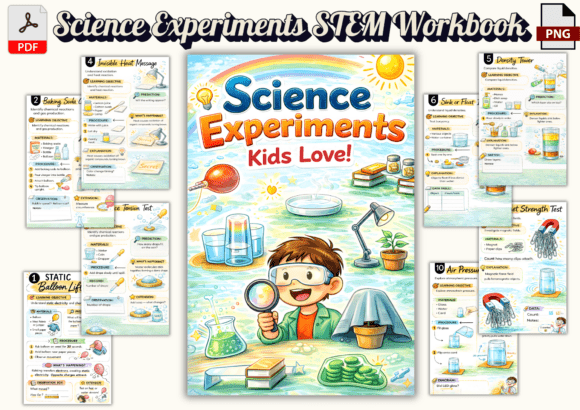
The Fun Science Experiments for Kids printable STEM workbook offers a practical, beautiful, and thoughtfully designed entry point into this world. With twenty experiments covering physics, chemistry, biology, and engineering, clear child-friendly explanations, and built-in observation and data recording spaces, it removes the barriers that often keep families and educators from doing hands-on science. Whether you are a parent looking for screen-free enrichment, a teacher building your lesson plan library, or a program leader seeking reliable activities, this resource delivers genuine learning wrapped in genuine fun. And in the end, that is exactly what science education should be.