Rethinking Early Education: Why the Early Learning Workbook for Kids Has Become an Essential Tool for Parents and Educators
The conversation around early childhood education has shifted dramatically over the past several years. What was once a straightforward choice between formal schooling and unstructured play has grown into a nuanced ecosystem of hybrid learning, curated resources, and intentional skill-building. At the center of this shift is a deceptively simple tool: the Early Learning Workbook for Kids. Whether you are a parent mapping out your child’s first learning experiences, an educator building classroom resources, or a content creator developing educational products, understanding the role and relevance of a well-designed workbook is no longer optional—it is essential.
This article explores what the Early Learning Workbook for Kids really offers, why it has become a focal point in the broader early education landscape, and how changing expectations from parents, teachers, and the market itself have elevated the workbook from a simple activity pad to a strategic learning instrument.
What Is an Early Learning Workbook for Kids? More Than Just Pages of Exercises
At first glance, a workbook might seem like a straightforward collection of tracing lines, counting games, and alphabet drills. But the Early Learning Workbook for Kids that has captured attention among professionals and parents alike is far more deliberate in its construction. It is not merely a set of worksheets bound together—it is a scaffolded learning journey designed to build foundational skills in a sequence that respects how young children actually develop.
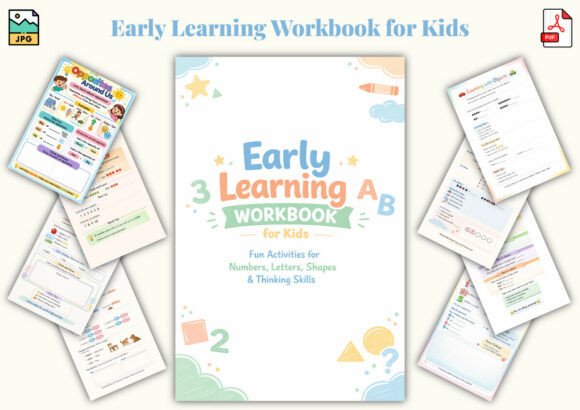
Take, for example, the Early Learning Workbook for Kids – Fun Educational Activity Book 32 Pages. With 31 unique activity pages out of 32 total, this workbook covers number recognition, counting, number tracing, alphabet learning, letter tracing, matching, patterns, shape recognition, creative drawing, simple addition and subtraction, days of the week, months of the year, colors, opposites, and progress tracking. Each page is intentionally minimal in layout, uses soft pastel tones to reduce visual overload, and focuses the child on one concept at a time. This is not accidental—it is a response to what cognitive research tells us about attention span, working memory, and motivation in early learners.
For professionals who design or choose learning materials, the distinction matters. A workbook that understands its user—the child—and the adult who facilitates the experience becomes a bridge between play and structure. It respects the child’s need for autonomy while giving the adult a reliable framework for guidance.
The Broader Shift: Why Workbooks Are Making a Comeback in a Digital Age
In a era dominated by screens, educational apps, and interactive tablets, it might seem counterintuitive that paper-based workbooks are experiencing a resurgence. Yet the data and market trends tell a different story. Parents and educators are increasingly aware of the drawbacks of excessive screen time—reduced attention spans, diminished fine motor practice, and passive consumption. The Early Learning Workbook for Kids offers a tactile, low-distraction alternative that actively engages fine motor skills, hand-eye coordination, and focused attention.
This is not about rejecting technology. It is about recognizing that different learning modalities serve different purposes. Digital tools excel at adaptive feedback and multimedia engagement, but physical workbooks excel at sustained concentration, pencil control, and the satisfaction of tangible progress. The forward-looking approach is not either-or but both-and. Professionals who understand this nuance are better equipped to recommend or create resources that fit into a blended learning ecosystem.
Moreover, the rise of homeschooling and micro-schooling has accelerated demand for structured yet flexible resources. Parents who take on the role of educator need materials that require minimal preparation, offer clear progression, and provide built-in motivation for children. The Early Learning Workbook for Kids meets that need precisely. It is a turnkey solution that does not sacrifice quality for convenience.
Changing Expectations: What Parents and Educators Now Demand From Learning Resources
The expectations for early learning materials have evolved significantly. Ten years ago, a workbook with colorful pictures and basic exercises was often considered sufficient. Today, the bar is higher. Parents and educators look for evidence of intentional design, developmental appropriateness, and alignment with recognized early learning standards. They also want resources that respect the child’s emotional and cognitive readiness.
The Early Learning Workbook for Kids – Fun Educational Activity Book 32 Pages reflects these changing expectations in several concrete ways. The page size of 6 by 9 inches is deliberately chosen to be manageable for small hands—not too large to overwhelm, not too small to frustrate. The inclusion of progress tracking and achievement pages speaks to the need for motivation and self-efficacy. Activities like matching, patterns, and opposites are not just academic exercises—they teach logical thinking, categorization, and real-world application.
Consider the simple addition and subtraction pages. Rather than introducing abstract symbols first, the workbook builds on counting and number recognition, then gradually introduces operations in a visual context. This mirrors the way children naturally develop number sense—through concrete experiences first, then symbolic representation. For the professional selecting materials, this is the difference between a workbook that works superficially and one that builds genuine understanding.
Another subtle but important feature is the inclusion of creative drawing and imagination tasks alongside structured exercises. This acknowledges that learning is not purely linear or logical. Creativity and open-ended exploration are foundational to problem-solving and self-expression. A workbook that balances structure with freedom is more likely to sustain a child’s interest over time.
The Market Context: Why Creators and Entrepreneurs Are Paying Attention
For creators, entrepreneurs, and marketers in the educational space, the Early Learning Workbook for Kids represents more than a product category—it is a signal of where the market is heading. The demand for high-quality, print-based early learning resources has grown steadily, driven by several converging factors.
First, the pandemic-era shift to home-based learning created a lasting awareness among parents about what their children are actually doing during the day. Many discovered that passive screen time was not enough to build foundational skills. They began actively seeking resources that required active participation. Workbooks fit that need naturally.
Second, the rise of the creator economy has made it easier than ever for independent educators, designers, and subject matter experts to produce and distribute workbooks. Platforms that support digital downloads, print-on-demand, and direct sales have lowered the barrier to entry. The result is a vibrant ecosystem of niche workbooks targeting specific skills, age ranges, and learning philosophies.
Third, there is a growing recognition that early learning resources must be culturally and contextually relevant. A one-size-fits-all workbook does not serve a diverse population of learners. The Early Learning Workbook for Kids that succeeds in the current market is one that can be adapted, personalized, or used flexibly across different settings—home, classroom, or on the go.
For entrepreneurs looking to enter this space, the key insight is that quality trumps quantity. A 32-page workbook with carefully designed activities and a clean, minimal aesthetic is often more valued than a 100-page workbook full of repetitive drills. Professionals who understand this can create products that command higher perceived value and stronger customer loyalty.
Practical Applications: How Professionals Use Workbooks in Real Settings
Understanding the theory is useful, but seeing the Early Learning Workbook for Kids in action reveals its true versatility. Consider a few practical scenarios drawn from real-world use.
Scenario 1: The Homeschool Parent. A parent with a 4-year-old and a 6-year-old needs resources that can be used with both children. The workbook’s range of skills—from letter tracing for the younger child to simple addition for the older child—makes it a single resource that adapts to different levels. The parent can use the progress tracking pages to celebrate small wins, keeping both children motivated. The compact 6 by 9 inch size means it travels easily to the library, the park, or a sibling’s extracurricular activity.
Scenario 2: The Preschool Teacher. A teacher in a mixed-age preschool classroom needs materials that support centers-based learning. The workbook can be pulled apart into individual pages or used as a whole. The matching and pattern activities work well as independent stations, while the tracing pages can be used in small groups with teacher guidance. The simple addition pages offer an early math challenge for children who are ready, without pressuring those who are not.
Scenario 3: The Grandparent. A grandparent who watches a young child a few days a week wants to engage the child in meaningful activities without needing to plan lessons. The workbook provides ready-to-go, high-quality activities that require no preparation. The pastel colors and clean layout appeal to the adult’s aesthetic sense while keeping the child focused. The grandparent can easily see the child’s progress and share it with the parents.
These scenarios illustrate why the Early Learning Workbook for Kids – Fun Educational Activity Book 32 Pages resonates beyond its immediate target audience. It serves multiple user types in multiple contexts, making it a versatile asset in any early learning environment.
Design Principles That Drive Engagement and Learning Outcomes
Behind the scenes of any effective workbook lies a set of design principles that are invisible to the end user but critical to the outcome. For professionals creating or selecting workbooks, understanding these principles is essential.
- Progressive difficulty. Activities should move from simple to complex, with each page building on skills developed earlier. The workbook’s sequence of number recognition, then counting, then tracing, then simple addition exemplifies this.
- Visual clarity. Young children process visual information differently than adults. Minimal layouts with ample white space, soft colors, and clear boundaries between activities reduce cognitive load and increase focus.
- Built-in feedback. Progress tracking and achievement pages provide immediate, tangible feedback that helps children see their own growth. This fosters a growth mindset and intrinsic motivation.
- Variety within structure. Repeating the same type of activity page after page leads to boredom. The workbook balances structured exercises (tracing, counting) with open-ended ones (drawing, imagination tasks) to maintain engagement.
- Real-world connections. Activities that reference days of the week, months, colors, and opposites help children see how their learning applies to everyday life. This contextualization strengthens retention and relevance.
For marketers and creators, these principles also inform how to position a workbook. Rather than leading with vague claims like “fun and educational,” the most effective messaging highlights specific design choices and their benefits. For example, “soft pastel colors reduce visual overwhelm” is more compelling than “beautiful design.” The Early Learning Workbook for Kids that communicates its design rationale builds trust with discerning buyers.
Looking Forward: The Evolving Role of Workbooks in Early Learning
As we look ahead, several trends suggest that workbooks will remain a staple of early education, but their form and function will continue to evolve. Personalization is likely to become more important. Parents and teachers increasingly want resources that can be tailored to a child’s specific needs rather than a generic one-size-fits-all approach. This could mean workbooks that offer branching paths, modular pages, or companion digital content.
Sustainability is another growing consideration. Print workbooks are physical products, and eco-conscious consumers are looking for responsibly sourced paper, soy-based inks, and minimal packaging. Professionals who factor sustainability into their workbook design and sourcing will appeal to a more discerning audience.
Finally, the integration of workbook activities with digital tools—such as QR codes linking to instructional videos or printable extensions—represents a hybrid model that combines the best of both worlds. The tactile focus of paper plus the interactivity of digital creates a rich learning experience that neither medium can achieve alone.
For the professional reader—whether you are a parent selecting resources, an educator designing curriculum, a creator building products, or a marketer positioning educational tools—the key takeaway is this: the Early Learning Workbook for Kids is not a relic of the past. It is a thoughtfully designed, research-backed tool that meets the real needs of today’s learners and their families. Understanding its purpose, its design principles, and its place in the broader educational landscape will help you make better decisions, create better products, and ultimately support better outcomes for children.
The Early Learning Workbook for Kids – Fun Educational Activity Book 32 Pages exemplifies what is possible when intentional design meets developmental science. It is a small but powerful example of how the right tool, used in the right way, can make a lasting difference in a child’s learning journey.