Reclaiming Space and Sanity: Why the Declutter Workbook Is the Tool Professionals Need
In a world that demands constant output, the environment you work and live in is rarely neutral. It either supports your focus or silently drains your energy. For professionals, creators, and entrepreneurs, the physical space around you is not just a backdrop — it is an active participant in your productivity, creativity, and mental clarity. Yet many of us find ourselves surrounded by piles of paper, digital distractions, and physical clutter that erode our sense of control. The Declutter Workbook has emerged as a practical resource for those who want to move beyond surface-level tidying and into a sustainable relationship with their space. But why is this simple workbook capturing the attention of professionals across industries? The answer lies in a convergence of lifestyle shifts, workplace evolution, and a deeper understanding of how environment shapes behavior.
Beyond Tidying: What the Declutter Workbook Actually Offers
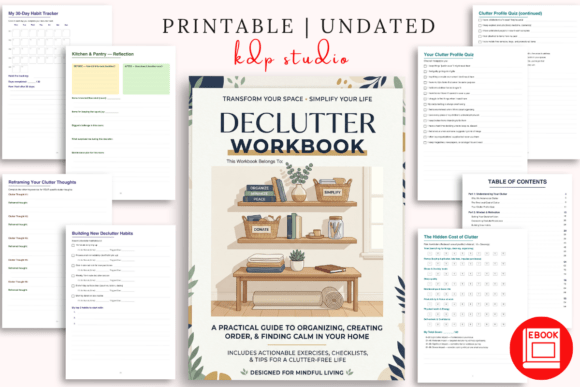
At its core, the Declutter Workbook is a 120-page guided system that helps you understand why clutter accumulates and how to create lasting order. It is divided into three distinct parts: understanding your clutter, shifting your mindset and motivation, and executing a room-by-room declutter plan. But calling it a "workbook" undersells what it really provides — it is part psychological exploration, part habit-building toolkit, and part strategic action plan. For professionals who often treat clutter as a problem to be solved with a weekend purge, the workbook offers something more durable: a framework for addressing the emotional and behavioral roots of disorganization.
The workbook begins with a Clutter Profile Quiz that helps you identify your specific organizational challenges. This is not a generic assessment; it surfaces patterns you may not have consciously recognized — whether you tend to over-collect, struggle with letting go, or use clutter as a buffer against decision fatigue. From there, it guides you through setting a clear vision for your space, overcoming the resistance that often stalls decluttering efforts, and building new habits that prevent reversion. The room-by-room plans are detailed but flexible, allowing you to apply professional-level systems to any space, from a single desk drawer to an entire home office.
Why Professionals Are Paying Attention
The rise of remote and hybrid work has blurred the boundaries between personal and professional environments. For freelancers, marketers, and creators, the home is no longer just a place to rest — it is a studio, a meeting room, and a production hub. This shift has introduced a new kind of friction: the same space that holds your work also holds your laundry, your children's toys, and your accumulated mail. The psychological cost of this overlap is real. Research on attention and cognitive load shows that visual clutter competes for neural bandwidth, making it harder to concentrate and easier to feel overwhelmed. Professionals are paying attention to the Declutter Workbook because it directly addresses this modern tension. It offers a structured, repeatable method for reclaiming control over an environment that now serves multiple high-stakes purposes.
Moreover, the workbook arrives at a time when the concept of "wellness" has expanded beyond diet and exercise to include environmental psychology. The spaces we inhabit are increasingly seen as determinants of mental health, creativity, and professional performance. Entrepreneurs and creators, who often operate without the structural support of a traditional office, are especially attuned to this. They understand that their output depends not only on skill and discipline but also on the quality of their surroundings. The Declutter Workbook speaks directly to this need, offering a practical path from chaos to calm without requiring a complete lifestyle overhaul.
The Psychology Behind the Mess: Why We Accumulate and What It Costs
One of the most insightful aspects of the Declutter Workbook is its emphasis on the "why" behind clutter. Professionals often assume that disorganization is a character flaw — a sign of laziness or lack of discipline. But the workbook reframes the issue: clutter is frequently a symptom of deeper patterns like fear of missing out, perfectionism, emotional attachment to objects, or decision fatigue. For a creative entrepreneur, holding onto supplies from an old project might feel like keeping options open. For a marketer, hoarding reference material can mask a fear of not having enough ideas. The workbook helps you identify these drivers in a non-judgmental way, which is essential for making lasting change.
The emotional cost of clutter is significant. It creates a low-grade stress that compounds over time, subtly eroding your sense of agency. When you walk into a room and feel a twinge of anxiety because of the mess, that is not a trivial feeling — it is your brain signaling that your environment is not safe or predictable. For professionals who need to make high-stakes decisions, manage teams, or produce creative work, this background noise is a liability. The Declutter Workbook does not just help you clear surfaces; it helps you quiet that noise so you can operate from a place of clarity rather than reactivity.
Changing Needs in a Post-Pandemic World
The pandemic permanently altered how professionals relate to their homes. What was once a sanctuary became a multi-functional workspace, school, and gym. Many people experienced firsthand what happens when boundaries dissolve: productivity suffers, focus fragments, and the line between "work" and "life" becomes indistinguishable. Even as the world has reopened, the habits and expectations formed during that period have persisted. Remote and hybrid work are now entrenched, and the home environment is more critical than ever to professional success.
The Declutter Workbook is relevant because it addresses this new reality directly. It is not a pre-pandemic organizing guide that assumes a tidy home is a luxury; it is a tool for professionals who need their space to function as a high-performing asset. The room-by-room plans are especially valuable for those who have repurposed a bedroom corner, a dining table, or a closet into a workspace. The workbook provides checklists and action plans that respect the practical constraints of living and working in the same square footage. It does not ask you to achieve perfection — it asks you to create a system that works for your actual life.
Practical Examples: From Desk to Living Room to Digital Life
Consider the typical freelancer's desk. It starts the week clean but by Wednesday is buried under notebooks, sticky notes, charging cables, and random receipts. The urge is often to do a quick shuffle — stack things into piles, hide them in drawers — but that is not decluttering; it is reorganizing the mess. The Declutter Workbook guides you through a different approach: you assess why each item is on the desk, whether it serves your current workflow, and where it belongs. The result is not just a clean desk but a workspace that actively supports your attention rather than competing with it.
For a marketer or entrepreneur running a business from home, the challenge extends beyond the desk to every room. Inventory from past product launches, promotional materials, and client gifts can accumulate quickly. The workbook's room-by-room framework helps you treat each area as a functional zone rather than a dumping ground. You learn to distinguish between items that are genuinely useful and those that are merely taking up space. This kind of discernment is a skill that transfers directly to other areas of life — including digital files, email inboxes, and even social media feeds.
The workbook also touches on the connection between physical and digital clutter. While it does not claim to solve your inbox problem, it lays the groundwork for a disciplined approach to organization that naturally extends to your digital life. Once you have experienced the mental clarity that comes from a decluttered room, you become more motivated to apply the same logic to your files and notifications. This makes the Declutter Workbook a gateway to broader organizational health.
Connecting to Larger Trends: Minimalism, Sustainability, and Intentionality
The growing interest in the Declutter Workbook aligns with several cultural shifts. Minimalism has moved from a niche aesthetic to a mainstream value, driven by concerns about sustainability, consumerism, and mental health. Professionals, in particular, are rethinking their relationship with stuff. They are asking: Does owning this object add value to my life, or is it just noise? The workbook operationalizes this question, giving you a structured process to answer it honestly.
Sustainability is another driver. The less you own, the fewer resources you consume, and the more intentional you can be about future purchases. For environmentally conscious professionals, decluttering is not just about personal peace — it is a form of stewardship. The workbook encourages you to donate, sell, or recycle items responsibly, turning a personal project into an act of environmental care. This resonates with a generation that wants their lifestyle choices to reflect their values.
Finally, the workbook taps into a broader desire for intentional living. Professionals are increasingly rejecting the default mode of accumulation and distraction. They want to design their homes, careers, and lives around what matters, not what happens to take up space. The Declutter Workbook is a tool for this design process. It helps you move from reactive to proactive, from overwhelmed to in control.
Building Lasting Systems: The Habit Component
One of the most valuable parts of the Declutter Workbook is its focus on habit formation. Many decluttering efforts fail not because the initial purge is incomplete but because the old habits return. The workbook addresses this directly with tools for building new routines that prevent clutter from re-accumulating. This is especially important for professionals who operate under time pressure. When you are rushing to meet a deadline, it is easy to toss a file on the counter or leave a box by the door. The workbook helps you design your environment and routines so that the default action is the organized one.
For example, it guides you in creating "landing zones" for incoming items, establishing daily five-minute resets, and setting up maintenance rhythms that are realistic for a busy schedule. These are not aspirational habits; they are practical, low-friction systems that work in the real world. The workbook acknowledges that professionals do not have endless hours to spend on organization. It gives you the minimum effective dose to keep your space functional and calm.
Who Benefits Most from the Declutter Workbook
While anyone can benefit from the Declutter Workbook, it is particularly well-suited for certain groups. Freelancers and solo entrepreneurs, who lack the external structure of an office, often find that their home environment directly impacts their income. For them, the workbook is an investment in productivity. Creators — writers, designers, artists — need mental space more than physical space, and clutter is a direct enemy of creativity. The workbook helps them clear the physical debris so the mind can roam freely. Marketers and business owners who juggle multiple projects and clients benefit from the systematic approach, which reduces decision fatigue and frees up cognitive resources for higher-level work.
Even professionals who work in traditional offices can use the workbook to organize their home environment, which in turn improves their overall well-being and work-life balance. The skills and mindsets developed through the workbook transfer to any context where order and clarity matter.
A Practical Path Forward
The Declutter Workbook is not a quick fix. It is a guide for a process that requires reflection, effort, and commitment. But for professionals who are tired of battling their own space, it offers a way out. It replaces the cycle of purge-and-rebound with a sustainable approach rooted in self-awareness and habit change. In an era where attention is the most valuable currency, reclaiming your physical environment is one of the most powerful moves you can make.
The workbook does not promise that you will achieve a perfect, Instagram-ready home. It promises something more meaningful: a space that reflects your priorities, supports your work, and gives you room to breathe. For anyone who has ever felt that their home was working against them, that promise is worth exploring.
Ready to transform your space and your mindset? The Declutter Workbook provides the structure, insight, and tools you need to create lasting order and calm in your home — and in your life.