Creative Drawing Workbook for Kids: Build Confidence and Skills Through Step-by-Step Art Adventures
Every parent or teacher knows the moment: a child picks up a pencil, looks at a blank page, and says, “I don’t know what to draw.” It’s a common hurdle in early creative development. Without guidance, many kids feel stuck or frustrated, believing they “can’t draw” simply because they haven’t been shown how to break a picture into manageable pieces. That’s where a structured resource like the Creative Drawing Workbook for Kids makes a real difference. Instead of assuming prior skill or artistic talent, this workbook meets children where they are—right at the beginning—and gently builds both ability and enjoyment.
Designed for children ages 4 to 10, the workbook transforms drawing from an intimidating task into a playful, step-by-step adventure. It uses basic shapes, clear instructions, and creative prompts that encourage kids to try, practice, and ultimately feel proud of their work. For adults seeking a practical, ready-to-use tool that supports independent learning and artistic growth, this workbook offers a straightforward solution.
Why Many Children Struggle to Draw—and How a Structured Workbook Helps
Young children often have big imaginations but lack the technical vocabulary to translate ideas onto paper. They might envision a dog, a castle, or a funny monster, but then get lost when trying to make it look “right.” This mismatch between imagination and ability can lead to frustration and a quick loss of interest. Common challenges include:
- Not knowing where to start on a blank page
- Feeling overwhelmed by complex images
- Comparing their work unfavorably to others
- Losing motivation after repeated attempts without progress
The Creative Drawing Workbook for Kids directly addresses these pain points. By breaking every drawing into simple shapes like circles, squares, and triangles, it removes the guesswork. Each step is small enough to feel achievable, and the finished result looks good enough to build genuine confidence. Instead of focusing on perfection, the workbook emphasizes the process—and that shift alone can re-engage a reluctant artist.
What Sets This Workbook Apart: Simple Shapes, Clear Steps, and Room to Explore
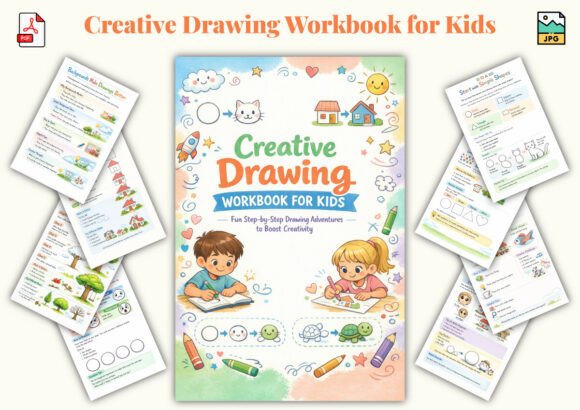
With 36 unique pages, the workbook covers animals, objects, characters, and more. But it’s not just a collection of coloring sheets or random prompts. Each activity is structured to teach a specific skill or concept, such as observation, proportion, or creative problem-solving. Here are some of the most valuable features from a parent’s or educator’s perspective:
- Step-by-step drawing guides that progress logically, so children never feel lost.
- Learning through basic shapes and lines, which helps kids see how complex forms are built from simple foundations.
- Creative challenges that go beyond copying—for example, adding a new element or changing an expression to spark imagination.
- Practice pages and reflection sections that encourage kids to think about what they learned and what they might try next.
- Drawing plans that let children set their own goals, fostering independence and ownership over their work.
These elements work together to create a resource that is both instructional and inspiring. The workbook is print-ready and available as high-quality JPG files, making it easy to use at home, in a classroom, or on the go. The 6×9 inch size is portable and manageable for small hands, yet large enough for detailed drawings.
Practical Ways to Use the Creative Drawing Workbook for Kids
Because the workbook is designed for flexibility, it fits naturally into many different routines and environments. Here’s how different users can approach it:
For Parents at Home
If you’re a parent looking for an after-school or weekend activity that doesn’t require screens, this workbook is an ideal choice. Hand it to your child and let them work through the steps at their own pace. The independent learning structure means you don’t need to be an artist yourself—the guides are self-explanatory. Many parents find that once a child completes a few pages, the confidence boost carries over to other creative pursuits, like writing or building with blocks.
For Homeschooling Families
In a homeschool setting, art is often the subject that gets pushed aside because of time constraints or lack of curriculum. The Creative Drawing Workbook for Kids solves that problem by offering ready-made lessons that align with skill-building goals. You can use a single page per day as a warm-up, or group several pages into a weekly art block. The reflection sections also provide a built-in way to discuss progress, making it easy to incorporate into a portfolio or assessment routine.
For Teachers in a Classroom
Elementary teachers can use the workbook for early finishers, as a calming down activity, or as part of a thematic unit. Because the content covers a range of subjects—animals, objects, characters—it complements science, reading, or social studies lessons. The step-by-step format also works well for whole-class instruction: display a page on a screen and guide students through each step together. This approach builds a shared vocabulary around drawing and reduces anxiety for less confident students.
As a Gift for Young Creative Minds
If you’re searching for a gift that goes beyond toys or gadgets, this workbook offers lasting value. It’s a gift that says, “I believe in your creativity.” For birthdays, holidays, or just because, it provides hours of engaging, screen-free fun that parents appreciate. Pair it with a set of good pencils or markers for an even more exciting package.
Real Outcomes: What Kids Gain from Guided Drawing
When children engage regularly with a structured drawing workbook, the benefits extend far beyond art class. The process of following step-by-step instructions while also adding personal touches develops several cognitive and motor skills:
- Hand-eye coordination improves as kids learn to control their pencil and match what they see.
- Focus and concentration build naturally because each drawing requires attention to sequential details.
- Observation skills sharpen as children begin to notice shapes, angles, and relationships between parts of an object.
- Creative thinking is strengthened through challenges that invite variation and personalization.
- Self-esteem grows with every completed page, especially when a child realizes they drew something they once thought was hard.
These outcomes make the workbook a practical tool not just for artistic development, but for overall learning readiness. A child who learns to break down a drawing into simple shapes is also practicing problem-solving strategies they can use in math, reading, and everyday life.
Choosing the Right Approach for Your Child’s Age and Skill Level
While the workbook is marked for ages 4–10, individual children will use it differently. Here are some tips for matching the experience to your child:
- Ages 4–6: Focus on the shape-based guides and let the child trace or copy freely. Don’t worry about precision. The goal at this stage is exposure and enjoyment. Use the creative challenges as conversation starters.
- Ages 7–8: Encourage following the steps more closely. Introduce the reflection sections and drawing plans. This is a great age to discuss what worked well and what they want to try next.
- Ages 9–10: Challenge them to use the workbook as a springboard. After completing a guided drawing, ask them to create an original character or scene using the same technique. The planning pages become especially useful here.
If you have multiple children, the workbook can be used simultaneously—each child works at their own level. The 36 pages provide enough variety to keep everyone engaged, and the print-friendly format means you can reprint favorite pages if needed.
How to Get the Most Out of the Workbook
To maximize the benefits, consider these simple practices:
- Establish a routine: Even 10–15 minutes a day can create momentum. Consistency matters more than length.
- Celebrate progress: Keep a folder or binder of completed pages. Looking back at early work versus later work shows growth and builds pride.
- Encourage experimentation: Remind your child that there’s no single “right” way to complete a challenge. Different results are a sign of creativity.
- Use the workbook alongside other art supplies: Colored pencils, markers, or crayons add another layer of fun and variety.
The Creative Drawing Workbook for Kids is more than a collection of activities—it’s a gentle, effective system for helping children discover the joy of drawing. Whether you’re a parent wanting to nurture creativity at home, a homeschool educator building a well-rounded curriculum, or a teacher looking for a reliable art resource, this workbook provides the structure and inspiration you need. By focusing on simple shapes, clear steps, and open-ended creative challenges, it turns “I can’t draw” into “Look what I made!”